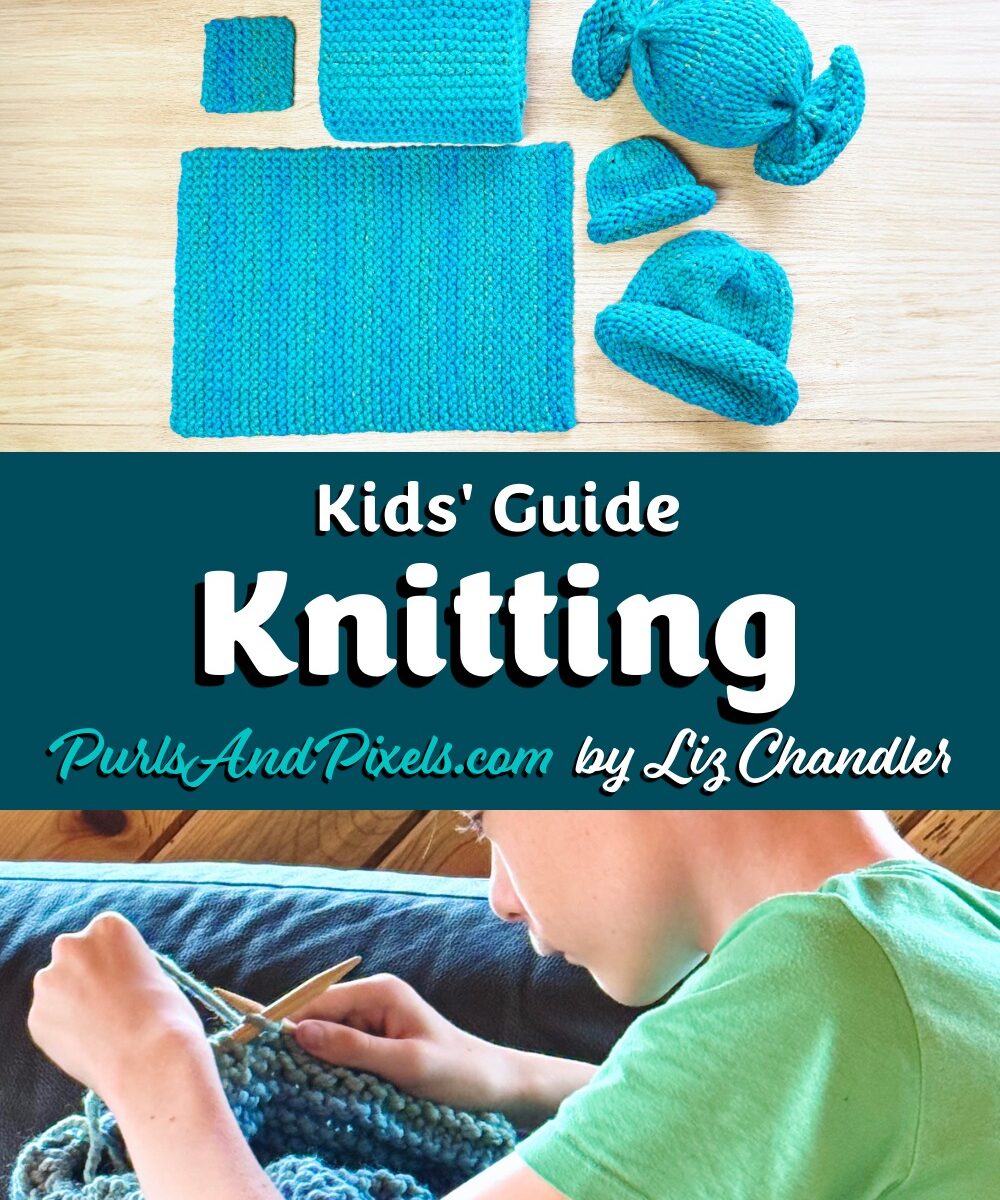
Kids’ Knitting Guide

Kids can learn to knit from the Kids' Knitting Corner knitting guide at PurlsAndPixels with fast cozy projects by Liz Chandler.

Step-by-step knitting lessons for kids 🧶

Hi, friends! Do you want to make your own awesome stuff? Did you know that with just one set of knitting needles and some fluffy yarn, you can create all sorts of fantastic things? That’s knitting. And I know you’re going to love it!

Knitting is a way to make fabric by looping yarn with two needles, one stitch at a time. In Kids’ Knitting Guide, you’ll learn how to knit step by step, starting with your very first stitch.

The Kids’ Knitting Guide is a guided series of knitting lessons made to teach kids to knit. In this series, you will learn basic knitting skills while making five useful projects.
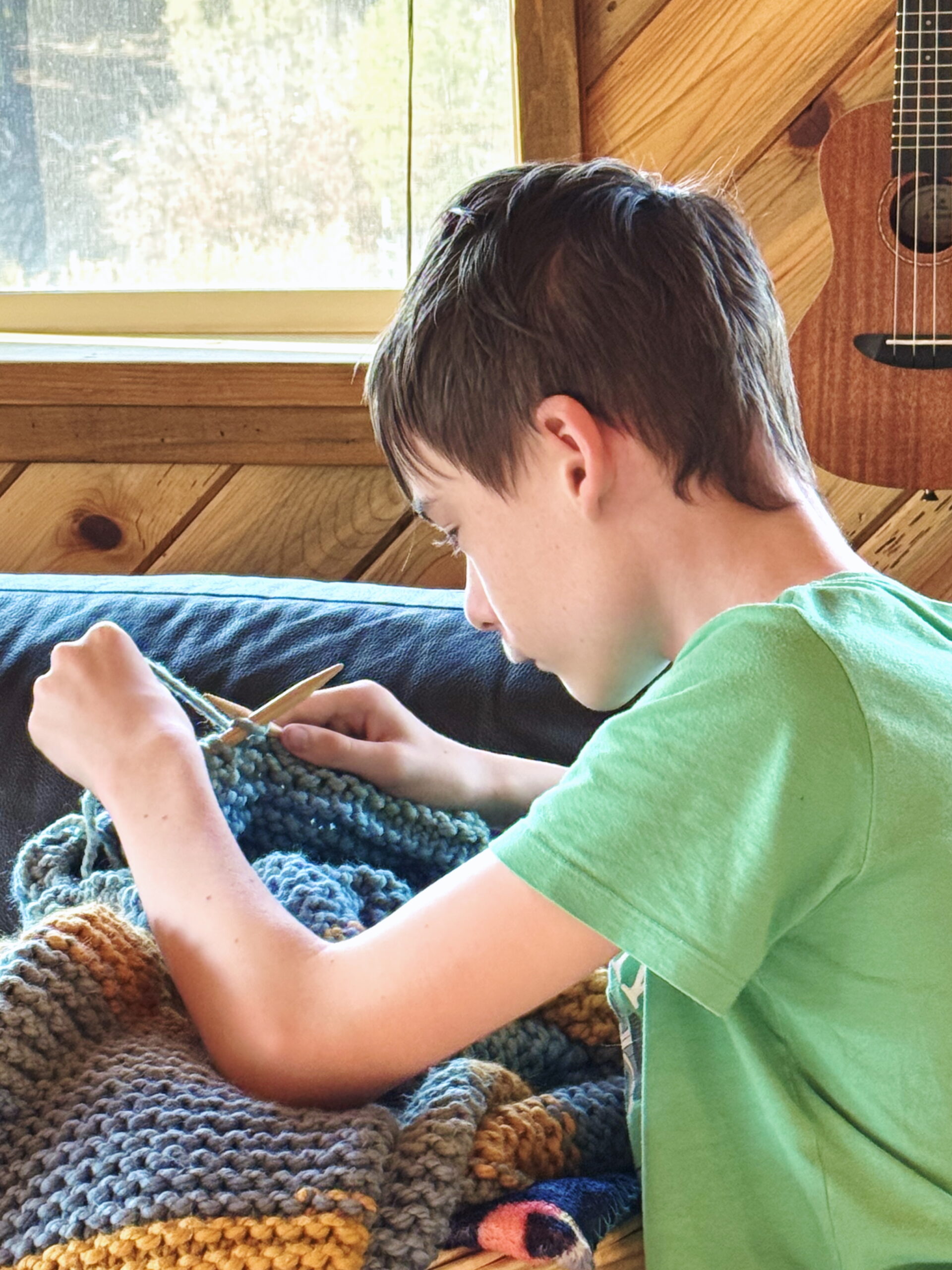
A boy knitting by the window learning to knit with super-bulky yarn with Liz Chandler's PurlsAndPixels Knitting Lessons.

What You’ll Learn Here

Start at Lesson 1 and follow the lessons in order to learn how to knit from the beginning.

Lesson missing? The series is being written now. I’ll add the next lessons to this page as they’re published, so you can come back here for the next step.

In this cozy corner, we will start right at the beginning. Together, we will:

If you are anything like me, you’ll want to be finished and use your project as quickly as you can. So, in these lessons you’ll knit with super-bulky yarn. This big, squishy yarn makes fluffy projects that will be finished in a flash.

If you ever feel stuck, just go back one lesson and try again. Knitting gets easier with practice.
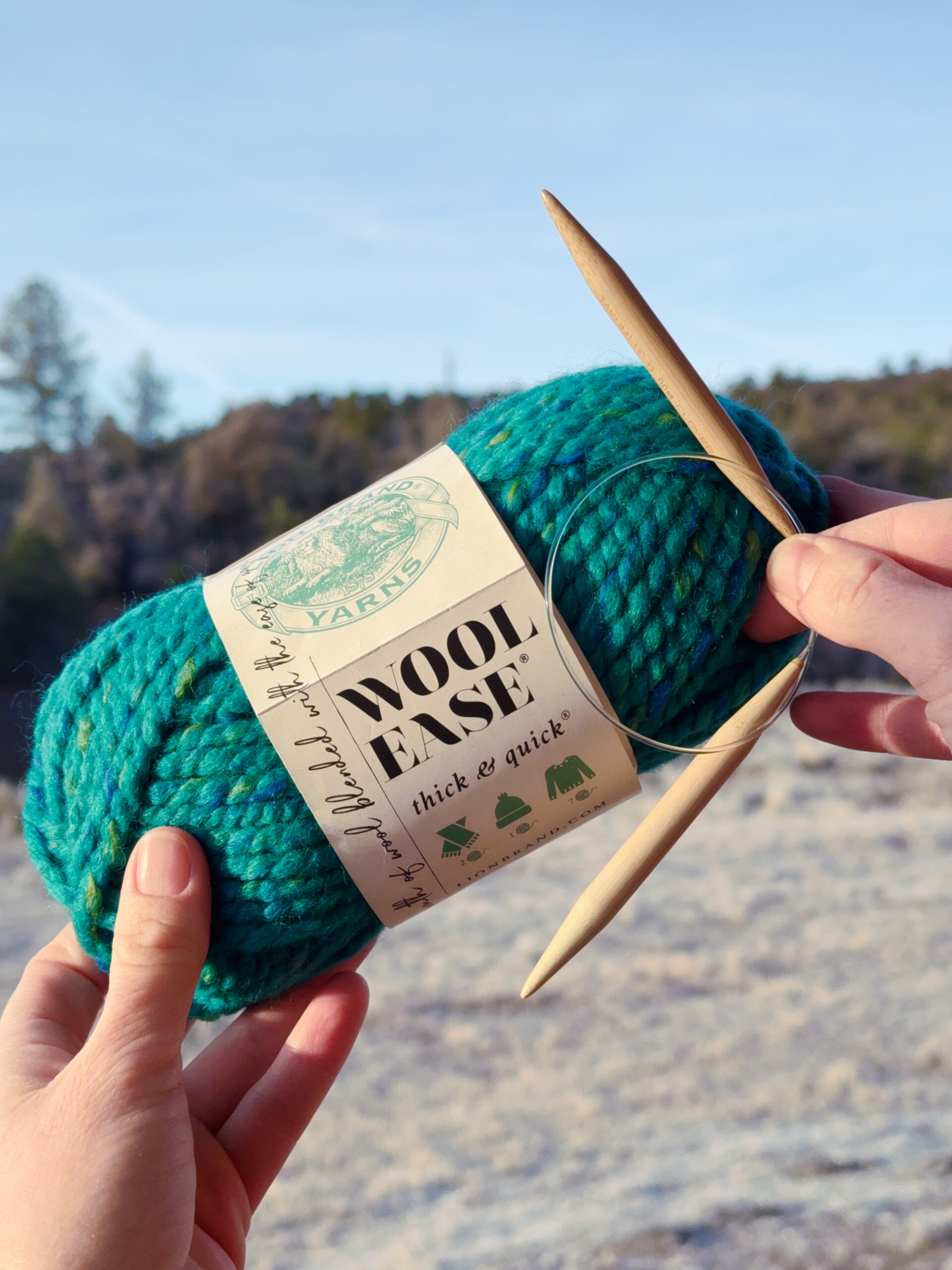
Kids' knitting lessons start with super-bulky yarn and US No. 13 needles, shown here outside held in front of a blue sky.

What You’ll Knit First

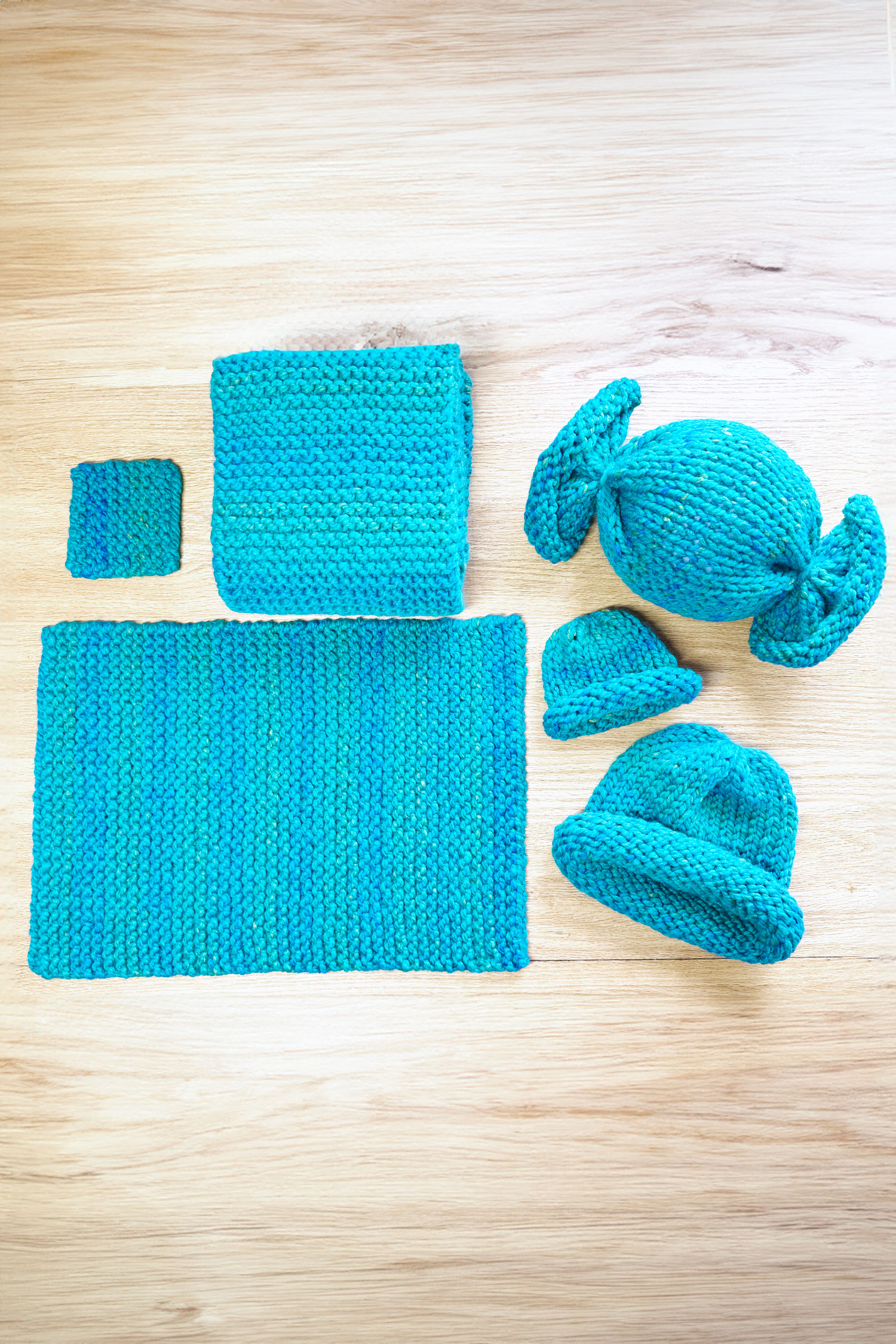
We will use this big yarn to let us learn more quickly, too. Every project you knit gives you a new skill. And the bigger the yarn, the faster the project. By the time you knit through this series, you will be able to make:

Kids' knitting projects on wooden table - coaster, placemat, scarf, hats, and a candy toy knitted in blue and teal super-bulky yarn.

Get Started

This is going to be fun! Start your first lesson: let’s pick out your yarn!

Want to knit the projects that go with these lessons? Explore the full Kids’ Knitting Guide Pattern Bundle with all five project PDFs in one convenient download.

🧷 Helpful Knitting Resources

Looking for more ways to support your knitting goals?

When Something Looks Wrong in Your Knitting

My knitting looks wrong. What do I do? Don't rip it all out. Get Liz Chandler's Guide to fixing common knitting mistakes.

(And How to Fix Knitting Mistakes Without Starting Over)

Something is twisted. It is not stretching right. Your knitting just looks… weird.

You will make mistakes knitting. But don’t let that be the reason you put the whole basket in the closet and walk away forever.

Most knitting mistakes can be fixed. If you are new to knitting, the Learn to Knit section walks through the basics from the very beginning.

This article explains what you are usually seeing when something looks wrong, how knitted fabric actually behaves, and how to decide what to do next without undoing hours of work. It focuses on recognition and judgment rather than step-by-step repairs.

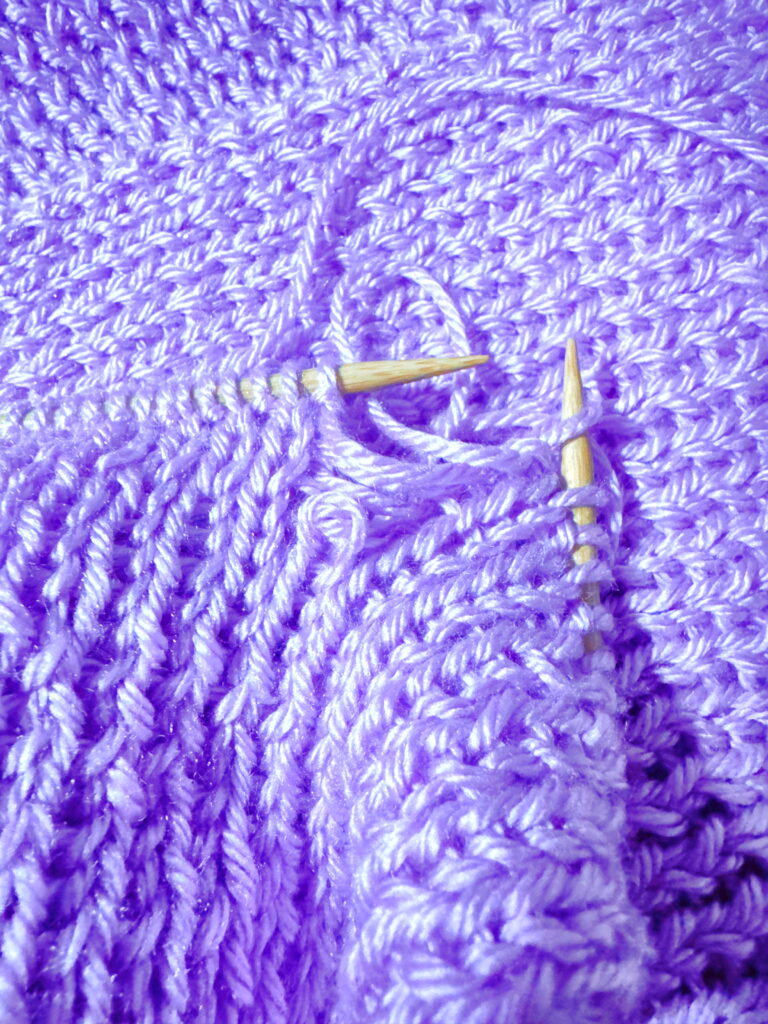
Knitted scarf with a dropped stitch that let a column of knitting drop - a mistake that can be fixed.

Most Knitting Does Not Need Immediate Fixing

When something looks off, it is easy to assume you have done something wrong and need to correct it immediately.

In practice, most things that look wrong in knitting are not urgent.

Knitted fabric is made of interlocking loops. Those loops support each other. While the work is still on the needles, the fabric often looks less even and less stable than it will once finished.

Uneven stitches, loose edges, and small visual inconsistencies are common. They often resolve themselves with continued knitting, blocking, or simple wear, and they do not weaken the fabric.

In many cases, the correct response is to keep knitting.

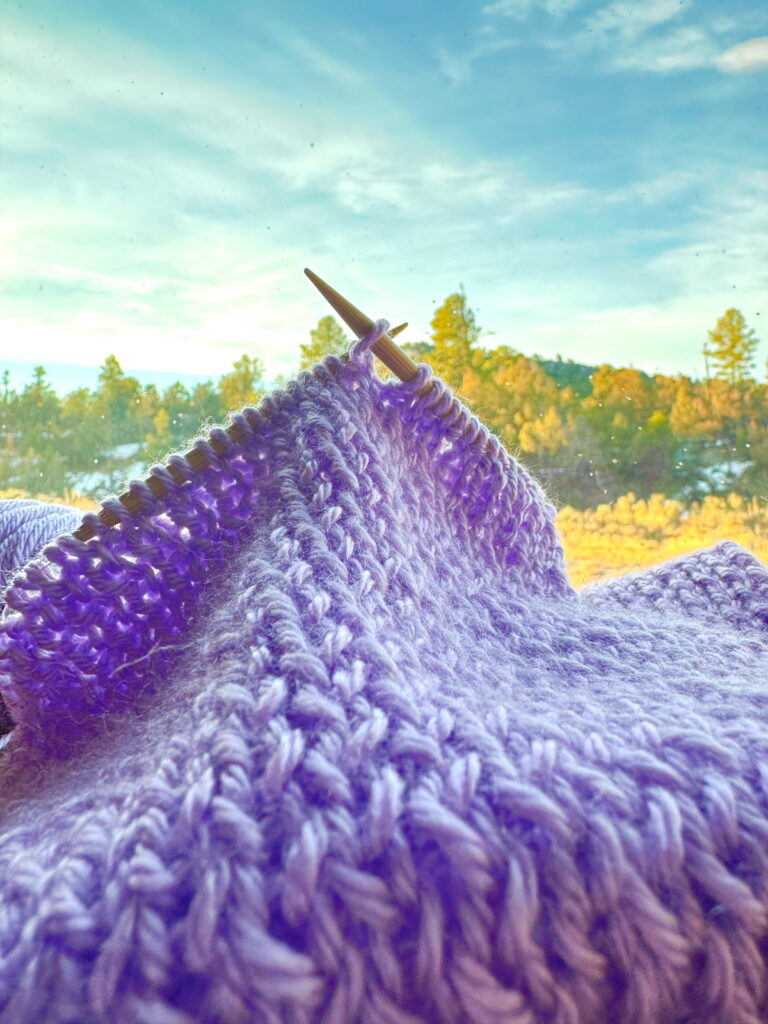
A knit scarf on the windowsill in front of mountain landscape shows how uneven tension can look like a mistake that needs to be ripped out. It does not: just block when finished.

Rows and Columns: How Knitting Actually Works

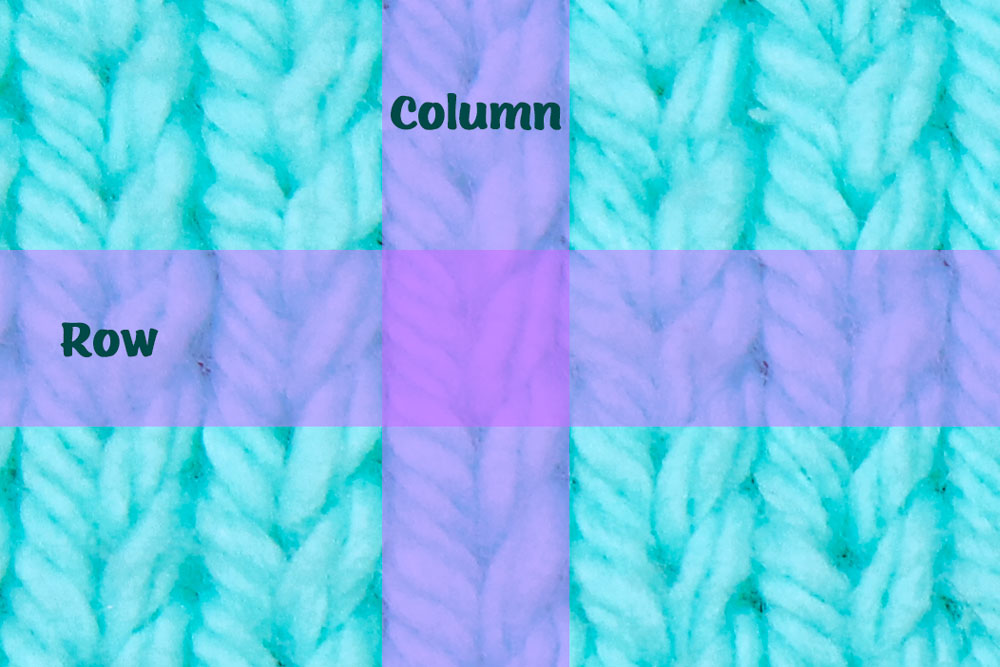
Although knitting is worked across the needles in rows, the fabric itself is built in vertical columns.

This infographic shows how knitting creates a fabric made of columns and rows.

Most true knitting mistakes exist in a single column of stitches rather than across an entire row.

Understanding this changes how you approach fixing problems and makes it easier to use targeted techniques instead of starting over. You are rarely repairing the whole project. You are usually working with one narrow section of fabric.

Because of this structure, many issues can be corrected later, or left alone entirely, if they do not affect the strength or function of the fabric.

Two Questions to Ask Before You Fix Anything

When you notice something that looks wrong, pause and ask:

  • Does this affect the structure of the fabric?
  • Will this continue to bother me if I leave it alone?

If the answer to both questions is no, continuing to knit is the best choice.

If the answer to either question is yes, the issue can usually be corrected by working to the column where it occurred, rather than undoing large sections of work. Many of these fixes are covered step by step in the Fix Knitting Mistakes lessons.

Why You Rarely Need to Rip Back Rows

Many knitters are taught that fixing a mistake means undoing rows (“frogging“) until the problem disappears.

While that approach works, it is often unnecessary.

Techniques such as knitting backward one stitch at a time (“tinking”) or dropping down a column to fix a stitch (“laddering down“) allow you to correct issues without starting over. If you want detailed, step-by-step instructions for specific fixes, my Fix Knitting Mistakes lessons walk through those techniques in depth.

Knowing that these options exist makes knitting feel less fragile and gives you more control over your work.

Many knitting mistakes can be fixed by laddering down to the problem and using a crochet hook to fix the column.

Confidence Comes From Knowing What You Are Looking At

Experienced knitters are not people who avoid mistakes. They are people who can recognize what they are seeing and decide whether action is needed.

That skill develops with practice and with an understanding of how knitted fabric behaves, rather than from memorizing instructions.

A Practical Next Step

If you find yourself pausing mid-row to decide whether something needs fixing, having a simple reference nearby can help.

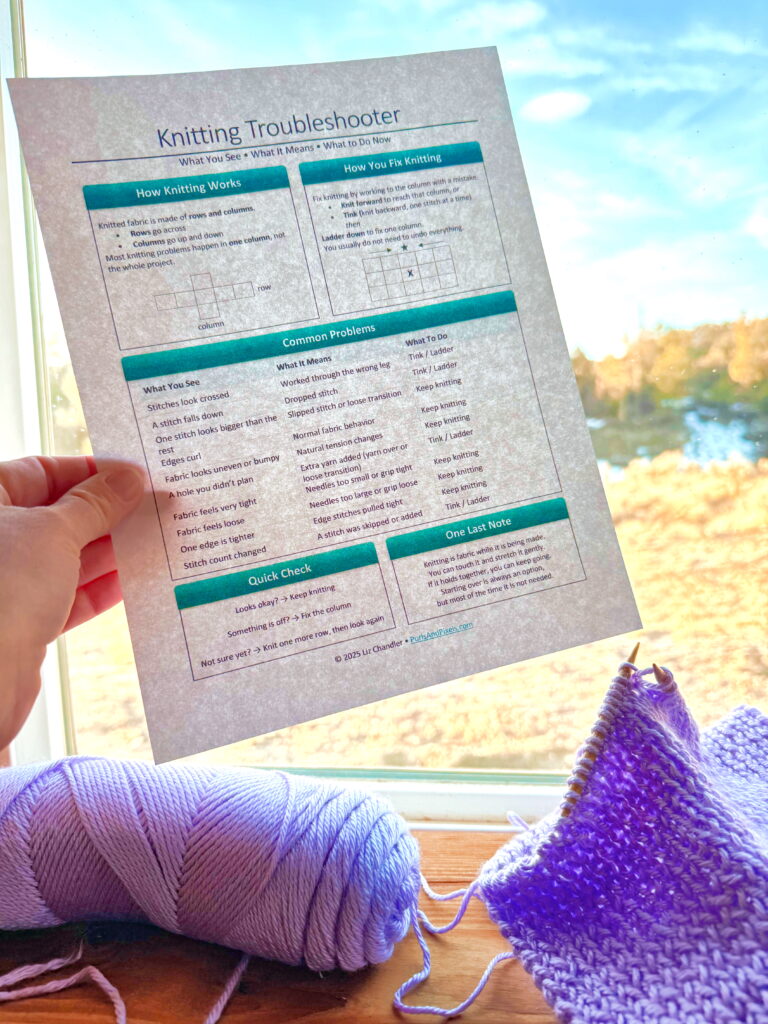
I put together a one-page Knitting Troubleshooter that outlines common situations, what they usually mean, and how to decide what to do next. You can find the Knitting Troubleshooter here if you want a printable reference to keep nearby. It is meant for the moment when you are holding your needles and thinking, “Is this a problem, or can I keep going?” It is designed to sit beside you while you knit and support your decision-making in the moment.

This article may be enough for some knitters. Others find it helpful to have a reference nearby so they can keep working without second-guessing each stitch or stopping to search for answers.

Printed copy of the PDF Knitting Troubleshooter in front of a window and winter mountain scene and a lavender knit scarf.

The goal is the same either way: continue knitting, learn as you go, and finish the projects you start.

Knitting becomes easier when it stops feeling fragile.

Most of the time, your work is sound.

Up Next

Now that you know something in your knitting needs fixing, find more detailed step-by-step lessons on how to spot and fix some of the most common knitting mistakes: twisted, sipped, and dropped stitches.

Learn to spot and fix simple knitting mistakes with this lesson from Liz Chandler @PurlsAndPixels.

Uneven tension can make it look like your knitting has mistakes. Don’t rip it out. Just keep practicing. In this lesson, we will learn how to make stitching more even by improving knitting tension.

Learn how to improve your knitting tension to avoid loose stitches and holes in your knits - a knitting lesson from Liz Chandler @PurlsAndPixels

Go Back to the Learn to Knit Index

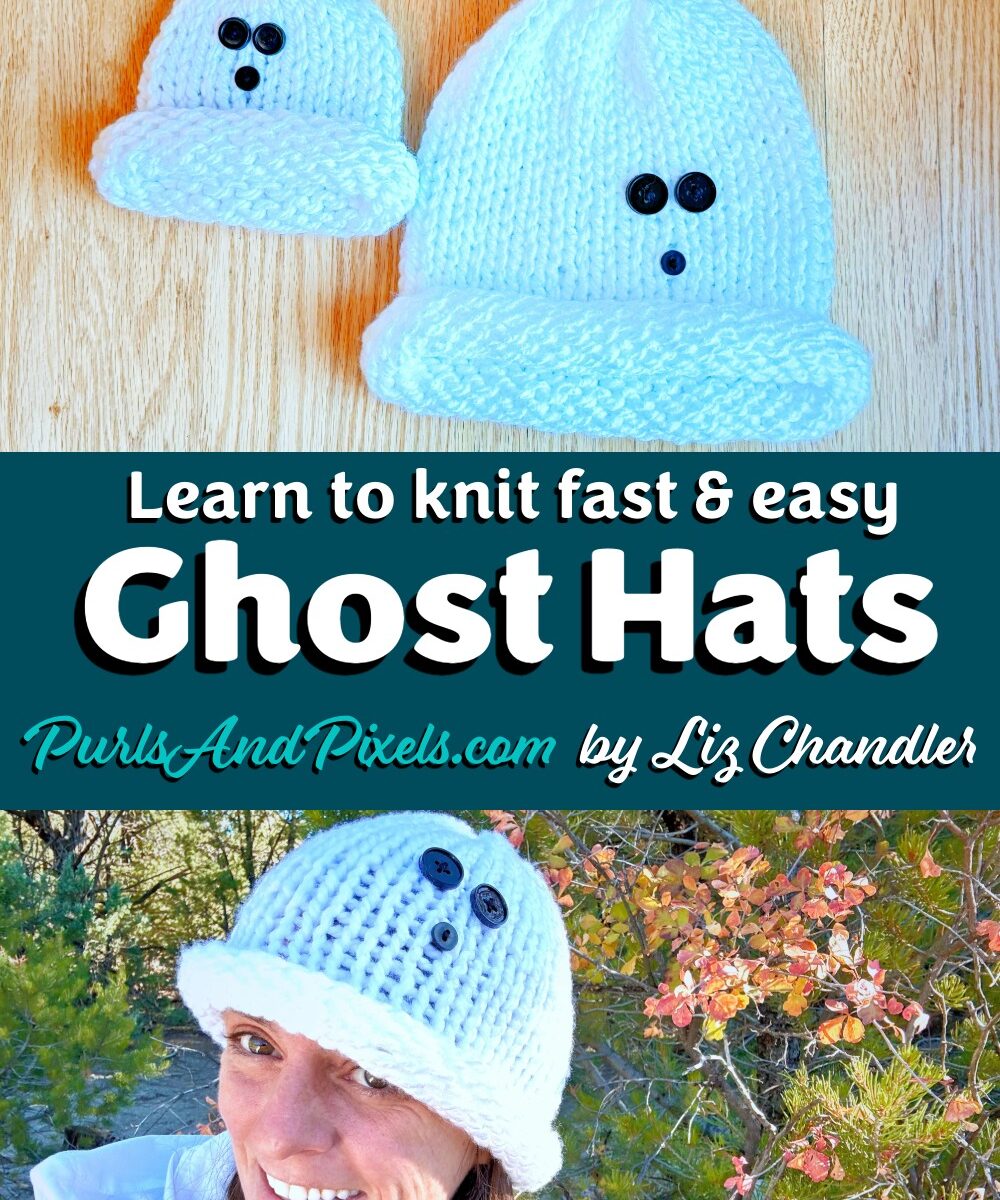
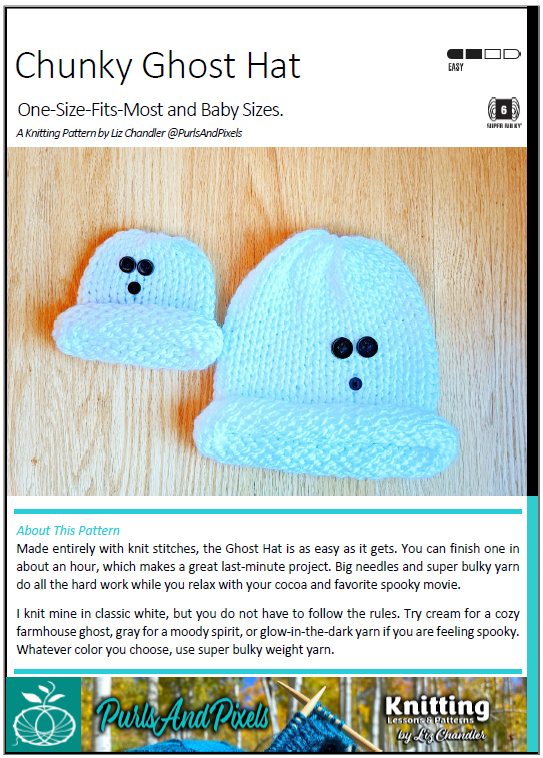
Chunky Ghost Hat Free Knitting Pattern

Learn to knit fast and easy ghost hats with the PDF knitting pattern by Liz Chandler @PurlsAndPixels.

by Liz Chandler @PurlsandPixels

Looking for a fast and festive knit? The Chunky Ghost Hat Free Knitting Pattern is a cozy, one-hour project perfect for Halloween or chilly fall days. Made with super bulky yarn and big needles, this hat is soft, spooky, and surprisingly simple. Knit one while you settle in with your favorite scary movie and a warm drink.

One time, when I was little, my dad was put in charge of Halloween costumes. He showed up to the store late, and the only thing left were clown wigs. My brother and I were terrified for all the wrong reasons, but we wore them anyway. They were itchy, plasticky, and ridiculous. This hat is for anyone who’s been there: short on time but still determined to have some Halloween spirit. 👻

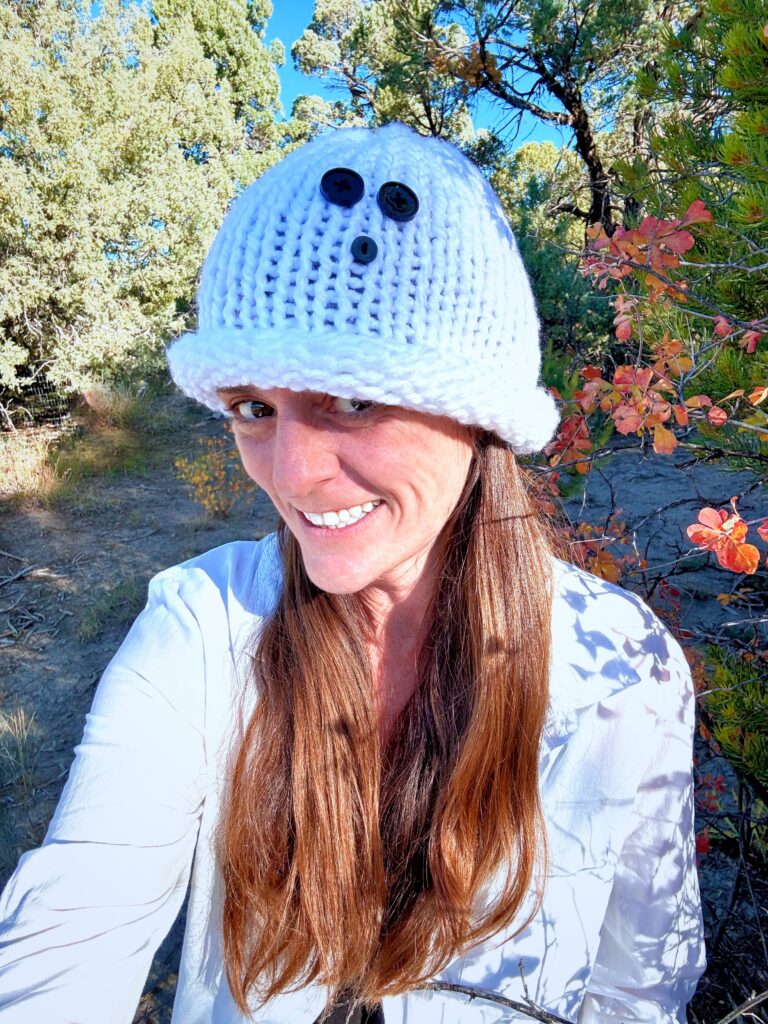
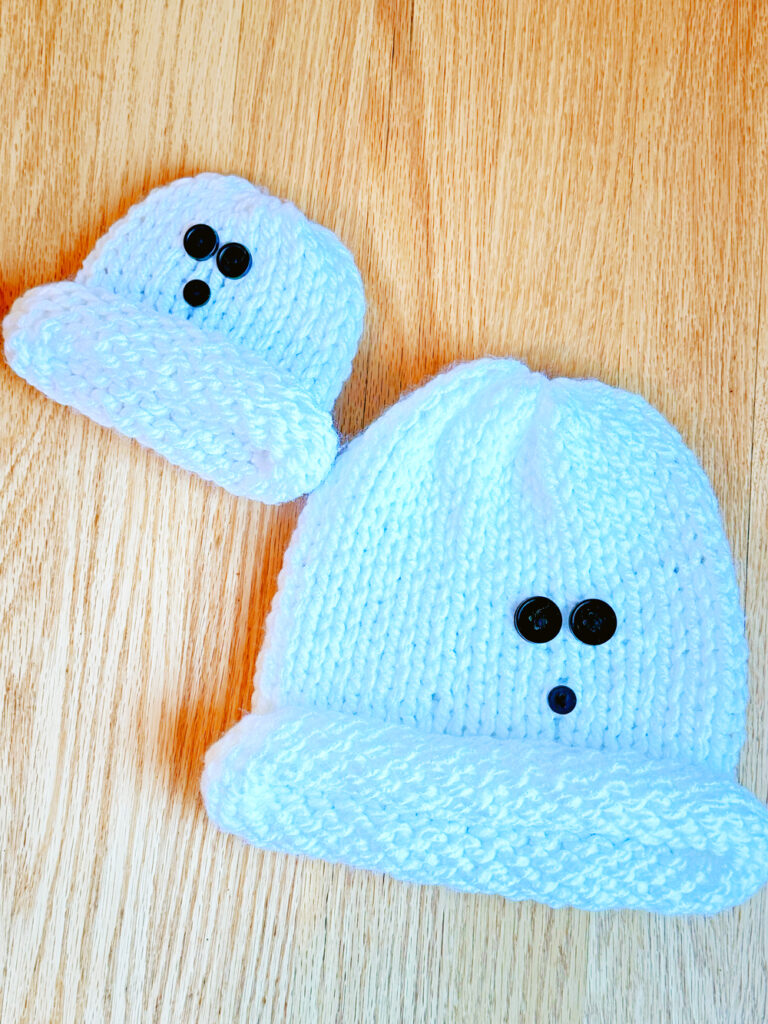
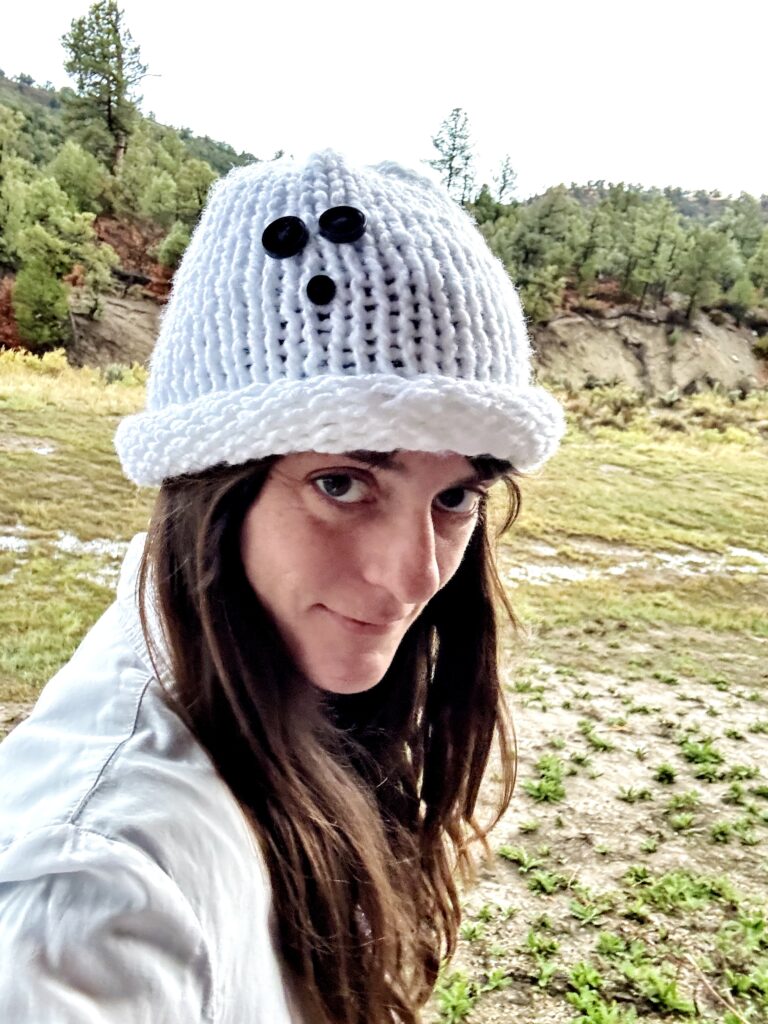
Liz Chandler's Fast & Easy Ghost Knit Hat PDF Knitting Pattern shown outside.

Prefer to knit offline? (Download the Printable Chunky Ghost Hat Knitting Pattern)

This pattern is free to read below, but if you’d rather print it or save it for later, I’ve created a clean, ad-free PDF version for you.

  • Includes complete, row-by-row instructions
  • Easy to print or use on your tablet
  • Supports my small business 💖
Get the chunky ghost hat knitting pattern pdf printable by Liz Chandler at PurlsAndPixels.

This chunky ghost hat has personality. Its wavy bottom edge looks like the fluttering feet of a friendly ghost, and the button eyes give it a playful face that says “boo.” It’s simple, forgiving, and perfect for beginners who want quick results without complicated stitches.

How this Chunky Ghost Hat Free Knitting Pattern is Made

This easy Ghost Hat is knit seamlessly in the round. You’ll use super bulky yarn and circular knitting needles to knit the hat from the bottom, up. When you’ve finished knitting, the hat brim will curl naturally. Just add three buttons (or felt circles) to make eyes and a little surprised mouth.

You will need to know how to:

Materials

Yarn

One 108-yard (3.5 ounce) skein of super bulky weight yarn* (shown in Bernat Softee Chunky yarn in the color “White”), in your choice of color.

  • Baby size uses about 27.8 yards (0.9 ounces)
  • One-Size-Fits-Most uses about 64.8 yards (2.1 ounces)

*Weights estimated with Bernat Softee Chunky yarn; other yarn weights may vary. Weight does not include gauge swatch.

Needles

Short Circular Needles
16-inch (41cm) long US No. 13 (9.0 mm) circular needle (or size needed to obtain gauge)

Notions

Gauge

7 stitches and 12 rows in stockinette stitch = 4 inches by 4 inches square. Learn how to check your gauge in this free knitting lesson.

Abbreviations

Instructions: Baby Size Chunky Ghost Knit Hat        

(10.5-inch to 16-inch [26.67-cm to 40.64-cm] head circumference)

Use the Long-Tail Cast On method. Knit in the round.

Row 1: Cast on 20 stitches. (20 stitches)

Row 2: Join the round (taking care not to twist stitches) and k 20. (20 stitches)

Rows 3 – 21: k 20. (20 stitches) [Work should measure 6 inches at this point.]

Cut yarn, leaving an 8-inch tail. With a darning needle, draw yarn tightly through the remaining 20 stitches. Weave in ends.

On the body of the hat, arrange the two larger buttons to look like eyes and the small button to look like a mouth. Sew on with thread or yarn that matches the buttons. For baby size, try to use safety buttons, crochet black circles, or felt pieces. (Never let babies play with an item that has regular buttons; they could choke.)

Instructions: One-Size-Fits-Most Chunky Ghost Knit Hat     

(16-inch to 25-inch [40.64-cm to 63.5-cm] head circumference)

Use the Long-Tail Cast On method. Knit in the round.

Row 1: Cast on 32 stitches. (32 stitches)

Row 2: Join the round (taking care not to twist stitches) and k 32. (32 stitches)

Rows 3 – 33: k 32. (32 stitches) [Work should measure 11 inches at this point.]

Cut yarn, leaving an 8-inch tail. With a darning needle, draw yarn tightly through the remaining 20 stitches. Weave in ends.

On the body of the hat, arrange the two larger buttons to look like eyes and the small button to look like a mouth. Sew on with thread or yarn that matches the buttons.

Printable version of this free knitting pattern

Printable Ghost Hat PDF Knitting Pattern

The simple Chunky Ghost seamless knit hat is made with just knit stitches has a naturally rolling brim. Get the PDF knitting pattern from Liz Chandler @PurlsAndPixels.

Care

If you use the materials called for in the Chunky Ghost Hat Free Knitting Pattern, your final product will be machine washable. To keep your Ghost Hat looking its best, hand wash or machine wash separately on delicate cycle in cold water. You may tumble dry on low heat or lay flat to dry.

🛁 Read more Knitwear Care Tips

This fast and easy chunky knit ghost hat is perfect for your very first project. Both kids and adults will love making these simple seamless knit hats with super bulky yarn. Get the free knitting pattern from Liz Chandler @PurlsAndPixels.

©2025, Liz Chandler of PurlsAndPixels.

This pattern is for personal use, gifting, and charitable donation of completed items. You may also sell handmade items created using this pattern. Do not copy this pattern and distribute it. If you’d like to share the pattern, refer your friends to my website, purlsandpixels.com so they may obtain a copy.

If you find any errors or have any questions, email purlsandpixels@gmail.com and I will do my best to help.

I’d love to see your finished work! Tag your photos with @PurlsAndPixels on Twitter or Instagram.

More Patterns You’ll Love

🎃 Pumpkin Hat and Gloves Knitting Pattern Set

🍬 Candy Pillow Toy Knitting Pattern

🧣 School Colors Scarf Knitting Pattern

❄️ Blue Snowflake Mitten Knitting Pattern

🧺 All Knitting Patterns from Liz @PurlsAndPixels: Learn to Knit All the Things

Read More

Don’t Miss a Stitch! 🧶

Love cozy knitting projects? Join me on YouTube, Pinterest, and Instagram! And don’t forget to sign up for my newsletter to get more free patterns, helpful tips, and updates straight to your inbox. 💌

What Does ** Mean in Knitting?

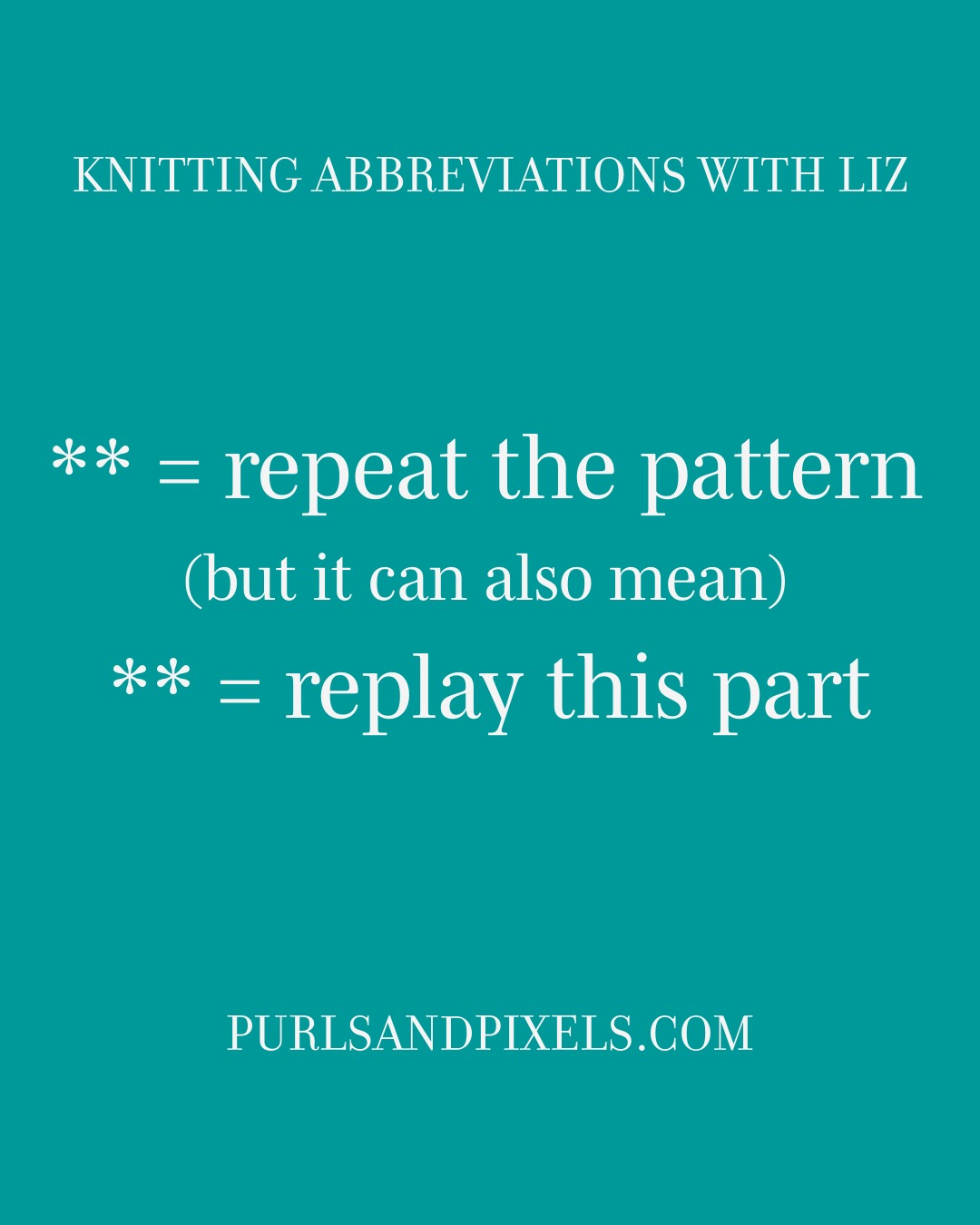
Knitting Abbreviations: ** = repeat the pattern or replay this part depending on your day. Find more knitting abbreviations from Liz Chandler @PurlsAndPixels.

Hint: Sometimes It Means Replay This Part 🎵🧶

In knitting patterns, * * marks a repeat. Whenever you see instructions framed by asterisks, it means “do this bit again.”
👉 Example: In a pattern written as *k, p* x 4, you would knit one stitch, purl one stitch, then repeat that pair four times total.

The Real Meaning of * * in Knitting

The asterisks are shorthand for repetition. Instead of writing the same directions over and over, designers put instructions between two stars and tell you to repeat them.

This is how you get ribbing, lace, cables, and all sorts of beautiful textures without filling pages with repeated text.

👉 Want a walkthrough? Check out my free guide on reading knitting patterns.

The Twist: * * = Replay This Part

Repeats can feel like déjà vu, but think of them like hitting replay on your favorite song. You already know the beat, you already love the rhythm, and now you’re just vibing while your needles do their thing.

Each repeat brings your project closer to harmony. It is muscle memory, rhythm, and a little bit of art all rolled into one.

So when you see * *, think of your knitting whispering: Replay This Part. Because sometimes, the best parts are worth doing again. 🎶

Knitting Abbreviations: ** = repeat the pattern or replay this part depending on your day. Find more knitting abbreviations from Liz Chandler @PurlsAndPixels.

Why Repeats Matter for Beginners

Repeats are what make patterns flow. Once you can follow the stars, you can handle anything from a simple ribbed scarf to a detailed lace shawl.

✨ Want to practice? Try these projects with easy repeats:

🧣 Beginner Ribbed Scarf

🥳 Wide Brim Ribbed Hat

🧼 Ribbed Washcloths

🛁 Seed Stitch Washcloths

These projects use knit and purl combinations with repeats, making them perfect for building confidence.

📚 Knitting Pattern Library: Explore more patterns

Find More Abbreviations

Visit the Knitting Abbreviations Main Page to see the whole series.

What’s Next?

Now that you know * * = repeat the pattern (and sometimes replay this part), you are ready to keep exploring knitting shorthand. Next up: more abbreviations that unlock advanced textures and designs.

🧭 Explore the other knitting abbreviations.

👉 Do not miss the rest of the series. Sign up for my email updates below and I will send the next lesson straight to your inbox!

It’s Getting Chilly

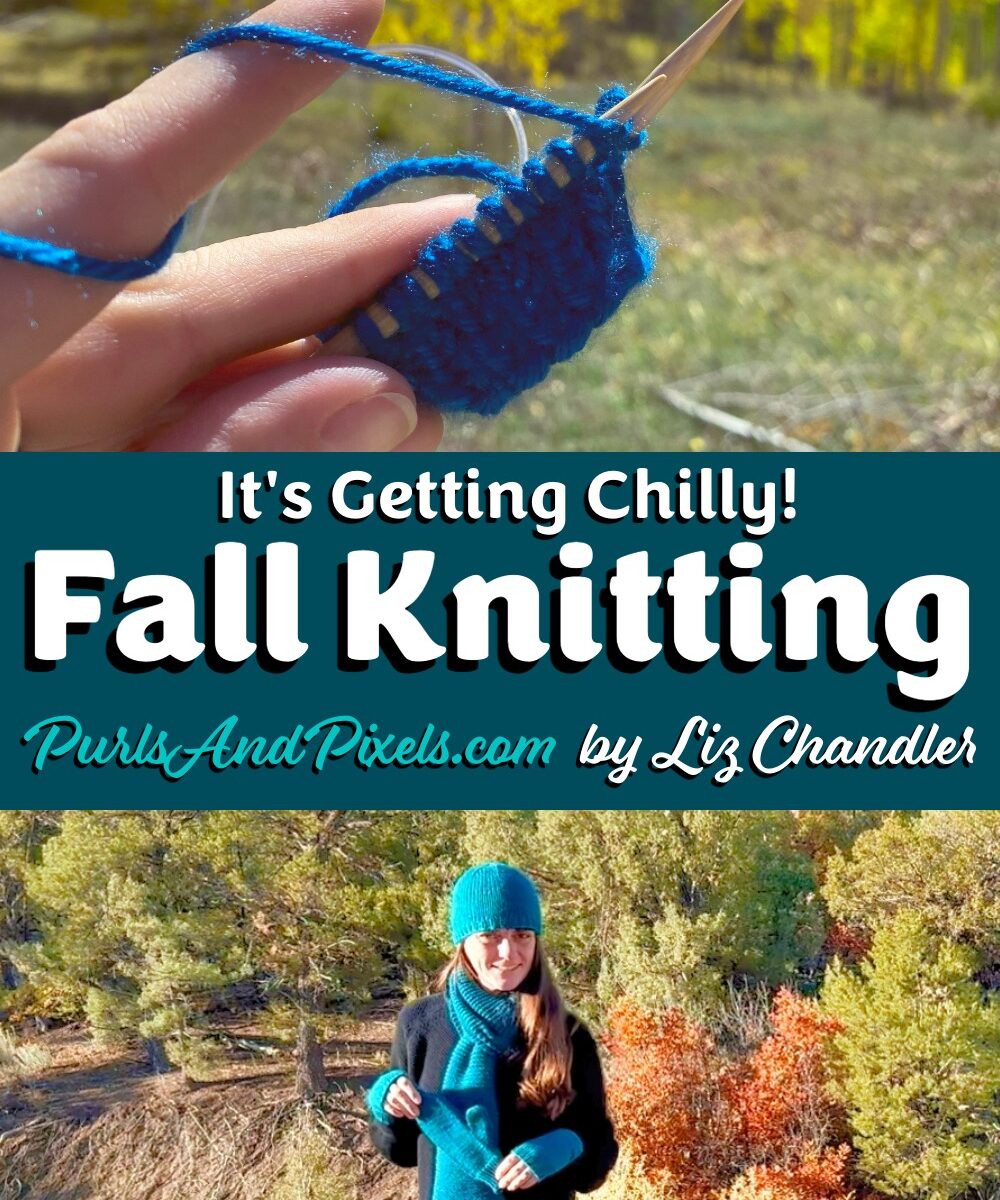
It's getting chilly! Explore fall knitting patterns and ideas from Liz Chandler @PurlsAndPixels.

Knit This Now, Stay Warm Later 🧣

You feel that, right? That first spark of cold that sneaks under your sleeves and makes you gasp, “Oh wow, it’s happening.” The trees are turning, your coffee’s steaming, your dog’s giving you that “you first” look at the door, and somewhere deep inside, your yarn starts calling, “Pick me! Pick me!”

This is our season, knitters. The moment we’ve been waiting for since June. The air is crisp, the sweaters are calling, and your needles? They’re about to get busy.

Before we get too far, check out my Fall Classics Bundle. It’s perfect for knitters of every level. This collection includes all the warm, cozy favorites for fall: scarves, beanies, mittens, and fingerless gloves. Mix, match, and layer your projects, and knit sizes for the whole family. It’s the perfect way to bundle up before the cold really hits!

At PurlsAndPixels, we’re not letting winter sneak up on us; we’re grabbing it by the wool and turning it into something soft, snuggly, and spectacular. So pick out your favorite skein, pour something warm, and let’s cast on.

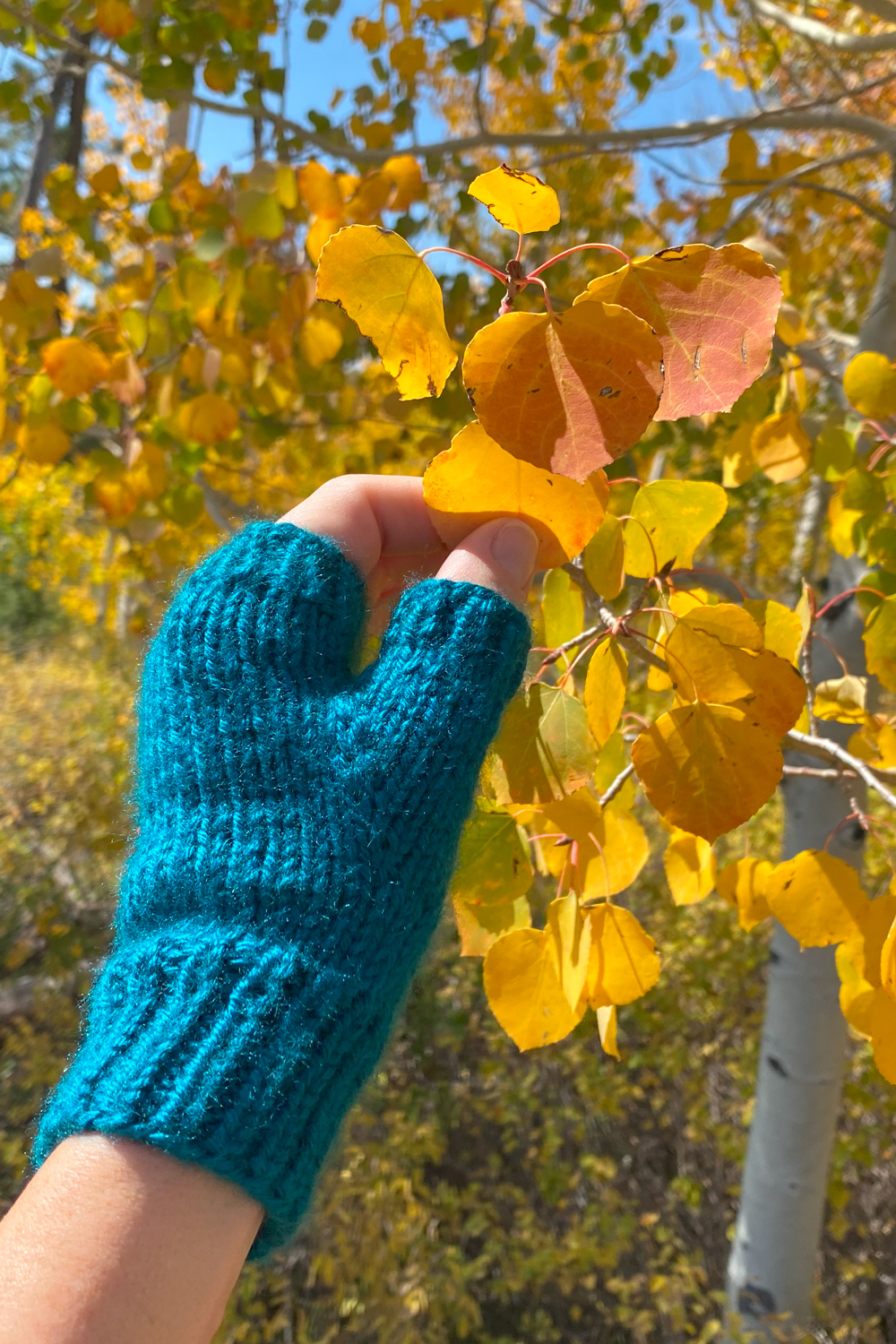
Liz Chandler's Fingerless Glove Knitting Pattern - a comfortable glove, perfect for autumn. Get the pattern at PurlsAndPixels.

🧤 Quick Projects (Because Instant Gratification Is Self-Care)

If you need a quick burst of accomplishment, start here:

  • Simple Beanie Hat: The world’s easiest way to look pulled together. One evening. One skein. Endless compliments.
  • Simple Mittens: Soft, warm, and surprisingly addictive. Fair warning: you’ll want to make them in every color.
  • Seed Stitch Washcloths: Textured, practical, and quick enough to make between cups of tea. They also make perfect gifts if you can bear to give them away.

Every pattern is ad-free, printer-friendly, and written in my “real human” language; no decoding required. Just you, me, and the click-clack of needles doing their thing.

Learn to knit the perfect fall accessories for everyone with this knitting pattern bundle by Liz Chandler @PurlsAndPixels.

🧶 Slow Knits, Big Payoffs

For the knitters who like to take their time (or just love an excuse to stay on the couch):

  • Rice Stitch Blanket: Cozy on day one, masterpiece by the end. Knit this and become the hero of your own snow day.
  • Single Row Striped Scarf: Chill, rhythmic, and perfect for a long movie marathon. The scarf that practically knits itself.
  • Subtle Cable Mittens: A little fancy, a lot of fun. Impress everyone without breaking a sweat.
With the Fall Classics knitting pattern bundle, you can knit a scarf, hat, fingerless gloves, and mittens. Grab the set of 4 fall knitting pattern PDFs by Liz Chandler @PurlsAndPixels.

☕ Why Start Now?

Because “later” never kept anyone warm, and procrastination won’t knit you a scarf.

Cast on tonight, and by the time that first snowflake falls, you’ll be ready with something handmade, beautiful, and uniquely yours. Every stitch is a love letter to your future self, saying, I’ve got you covered.

Now grab your yarn, light that candle, and knit like the world’s depending on your coziness. Because around here, we don’t just survive the season; we style it.

Fall hat and gloves knitting patterns by Liz Chandler @PurlsAndPixels

✨ Come Get Cozy with Me

Want to dive right in? My Fall Classics Bundle is the perfect place to start – packed with easy, cozy projects to build skills fast while keeping you warm and happy.

If you’re a layering fan, these patterns are perfect for building your cold-weather wardrobe. Mix and match your makes: mittens, beanies, scarves, and blankets that work together to keep you stylish and warm. And if you’ve got leftover yarn from past projects, turn it into something new! Every one of these makes a fantastic stash-buster and helps reduce waste while keeping your creativity rolling.

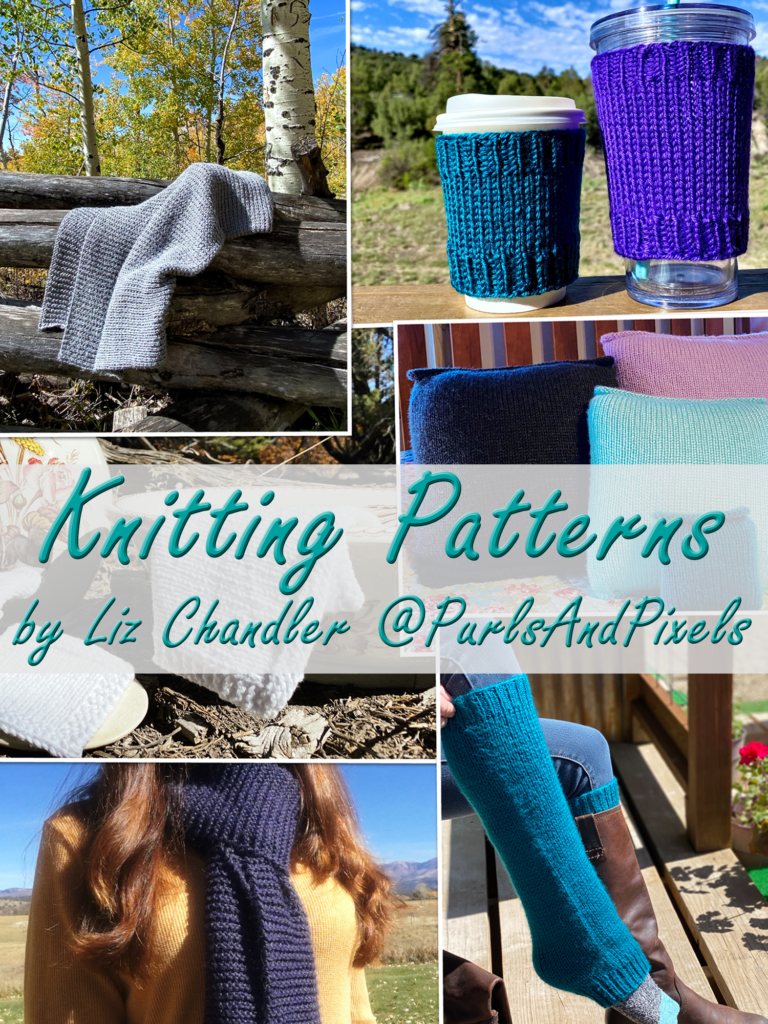
Explore All My Knitting Patterns

All these patterns, and dozens more live in the PurlsAndPixels Pattern Library. You’ll find lessons, printable PDFs, and enough cozy chaos to keep your needles dancing all season long.

Need knitting supplies? Explore my curated ideas Amazon here (affiliate link).

💌 Want in on the fun? Join my email list for new patterns, cheeky tips, and exclusive deals. No spam, no fluff, just stitches, sass, and cozy energy. Sign up for newsletters ⬇️

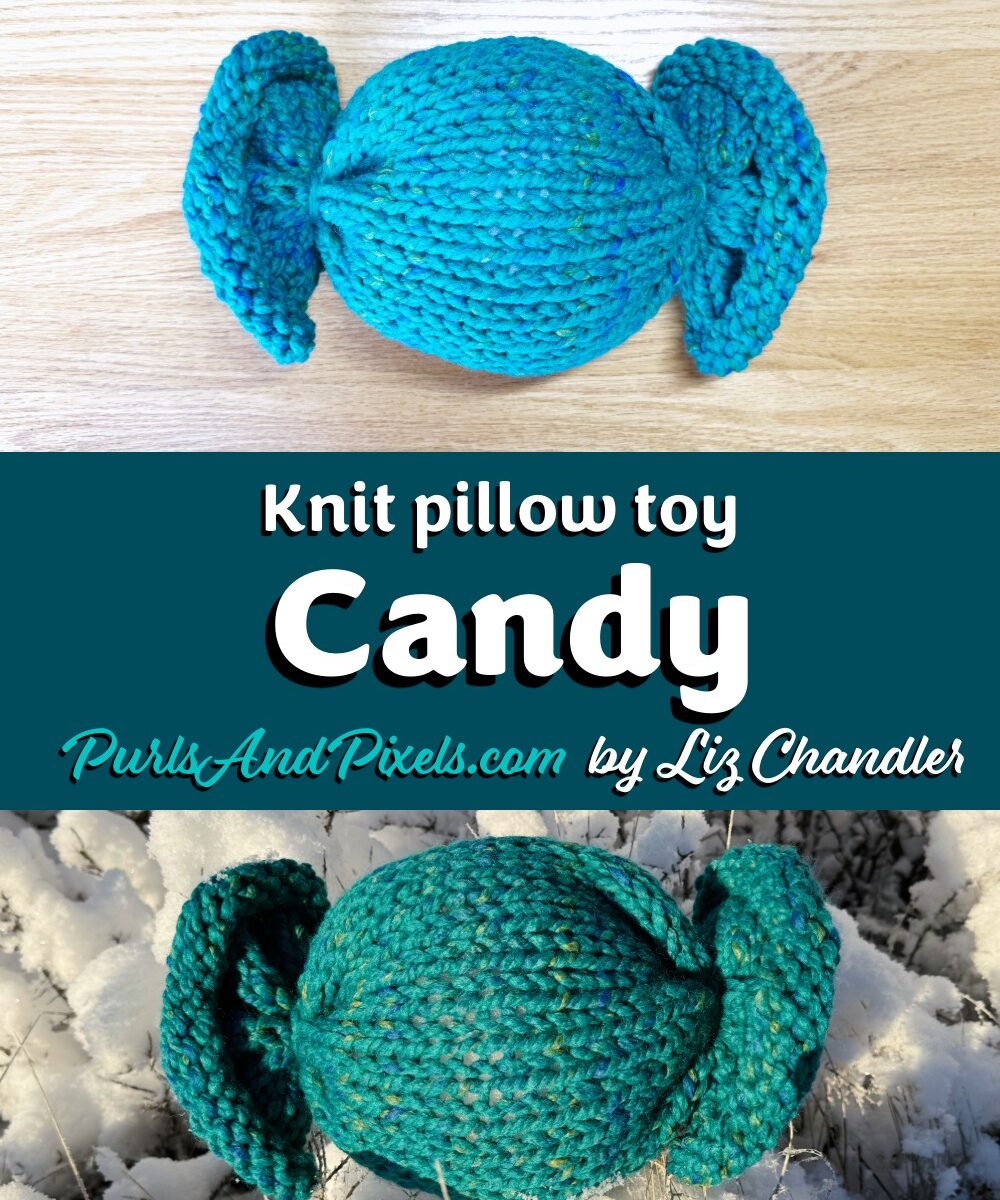
Candy Pillow Toy – Free Knitting Pattern

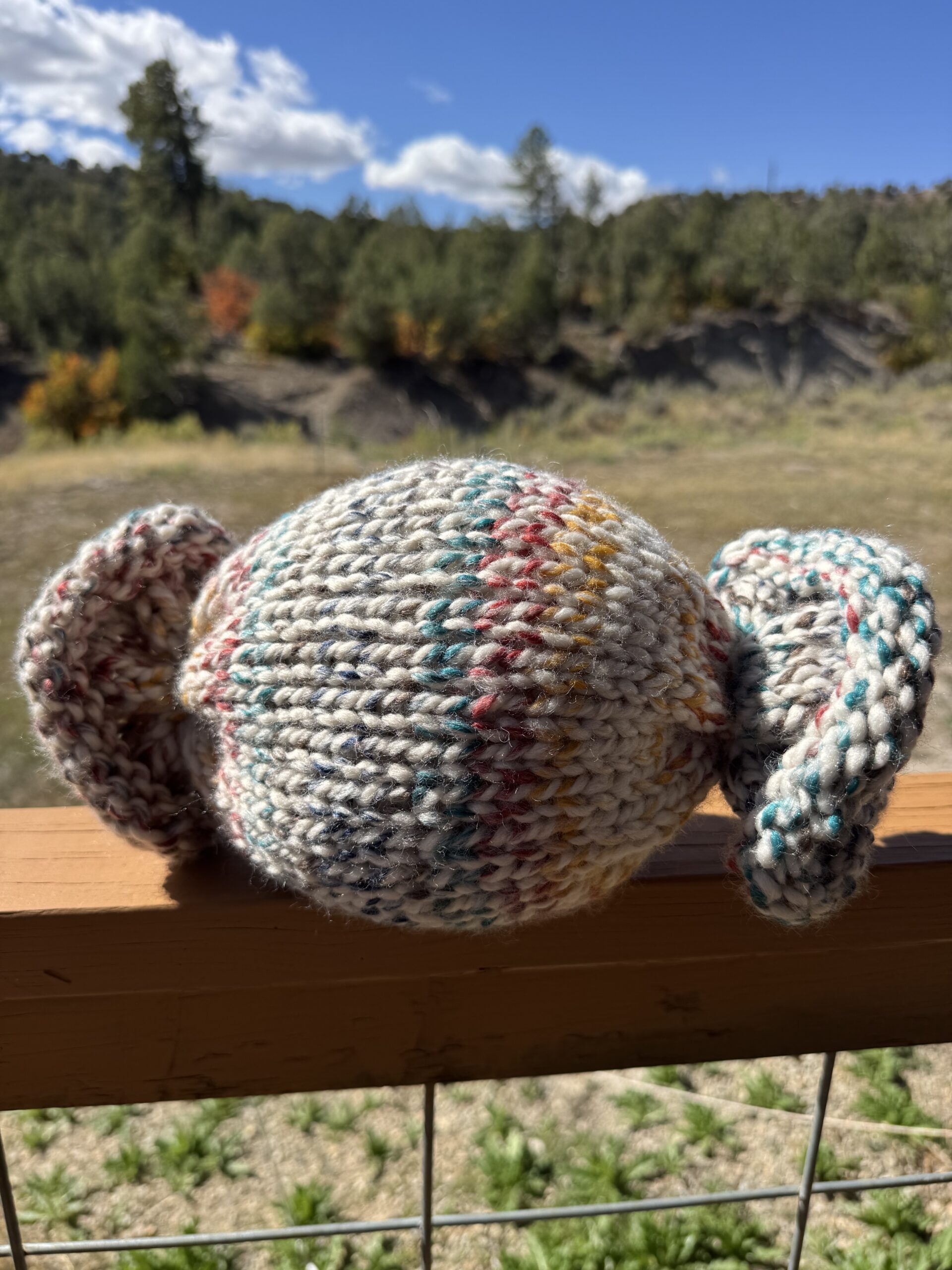
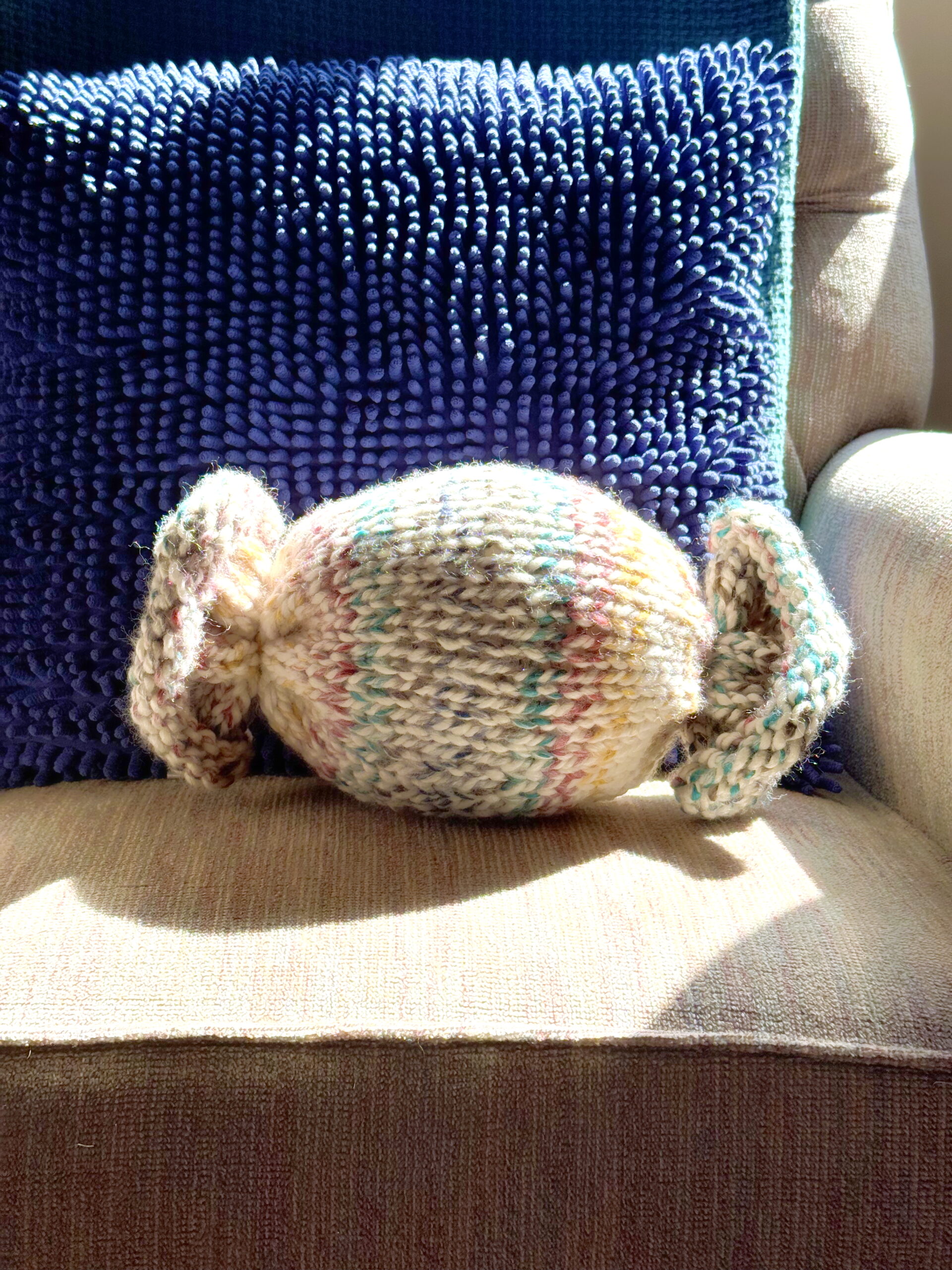
Knit candy pillow toys made with the free knitting pattern shown on natural surfaces.

This super-bulky candy toy pillow is intentionally designed as a final confidence-building project for beginner knitters and has been used successfully by kids and adult beginners completing their first series of knitting projects. The pattern limits techniques to the knit stitch, uses simple tube construction worked in the round, and works with thick yarn so stitches remain easy to see while reinforcing consistency over a longer piece. There is no purling, no stitch pattern changes, and no shaping during the main body of the project.

This article explains how to knit a super-bulky candy-shaped toy pillow, with step-by-step instructions suitable for complete beginners. You will knit a tube in the round using only the knit stitch, stuff the pillow, and tie the ends closed to create a soft, playful toy pillow that feels substantial and rewarding to finish.

The sweetest knitting project around. Knit the free and easy candy pillow toy with knitting instructions in this pattern by Liz Chandler @PurlsAndPixels.

On this page: About · Materials · Gauge · Printable PDF · Instructions · Care · Sharing

About This Super-Bulky Candy Pillow Toy

This toy is designed to feel simple and doable. The tube grows quickly, the stitches are easy to see, and the finishing steps are straightforward. When you are done, you will have a soft candy-shaped pillow that can be used for pretend play, room decor, or a silly gift.

This pattern is knit in the round using only the knit stitch. There is no sewing. You will close the ends by tying them with yarn, then fluff the center into shape.

Materials

Knitting Needles

16-inch (41 cm) long US No. 13 (9 mm) circular needle (or size needed to obtain gauge)

Yarn

One 106-yard (6-ounce) skein of super-bulky (No. 6) yarn* (shown here in Wool-Ease Thick and Quick by Lion Brand Yarn “Hudson Bay” and “Bluegrass“), in your choice of color).

  • One pillow toy uses about 106 yards (6 ounces)

*Weights estimated with Wool Ease Thick & Quick by Lion Brand Yarn; other yarn weights may vary.

Stuffing

A soft fiber toy/pillow filling like PolyFil.

Notions

Gauge

10 stitches x 18 rows = 4 x 4 inches in garter stitch on No. 13 (9.0 mm) needles.
Gauge is typically measured in stockinette stitch, and because this toy is worked in the round using only the knit stitch, the finished fabric is stockinette. However, gauge is measured in garter stich here for consistency with the other kids’ knitting patterns. Exact gauge is not critical for this project.

Abbreviations

k = knit

Skills Used

This super-bulky candy pillow toy is a great early project because it is simple, fast, and easy to finish.

To make the super-bulky candy pillow toy, you’ll only need to know how to

If you need help, there are instructions and video tutorials here on PurlsAndPixels for every step you’ll take:

This toy is knit in the round using only the knit stitch. Repeating the same motion over a short project like this is a great way to build confidence and get comfortable with tension.

Try to keep your stitches snug, but not tight. They should slide easily on the needle so you can insert your needle into each loop without forcing it. This pattern is a simple place to practice finding that balance.

Want to knit along with me? I’ve linked a video lesson on this page that shows the full project from cast on to finishing. 🧶

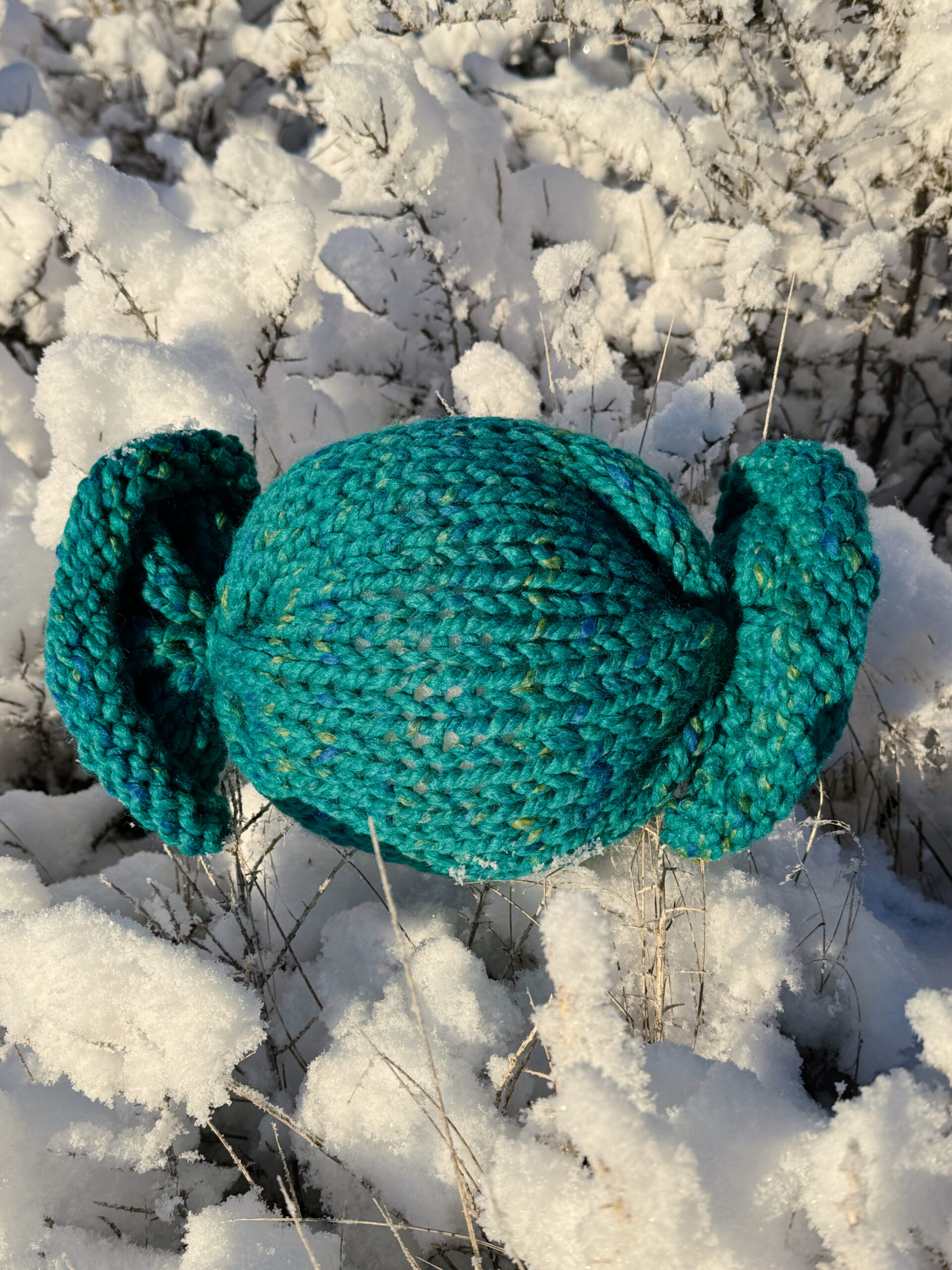
A blue knit candy toy made in the color "Bluegrass" sits on fresh snow.

Prefer to knit offline?

This pattern is free to read below, but if you’d rather print it or save it for later, I’ve created a clean, ad-free PDF version for you.

  • Includes complete, row-by-row instructions
  • Easy to print or use on your tablet
  • Supports my small business 💖
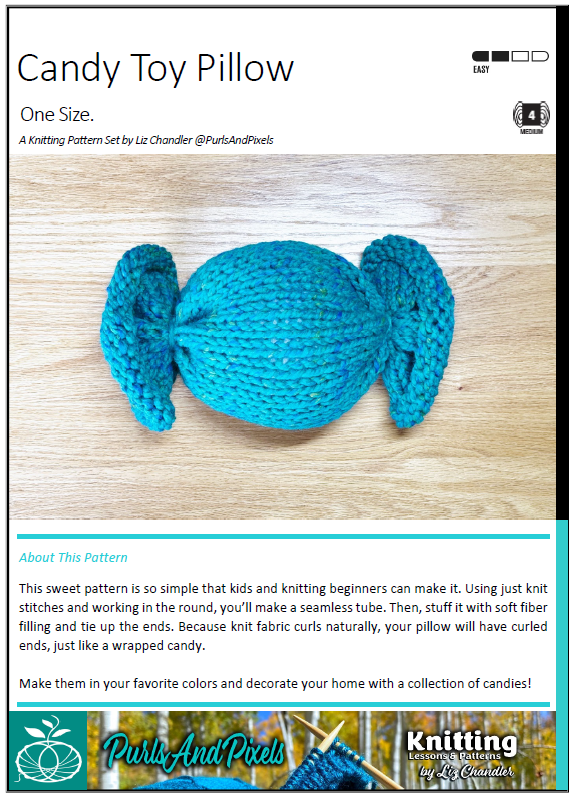
Beginner Super-Bulky Candy Pillow Toy Knitting Pattern PDF download cover page.

Instructions: Super-Bulky Knit Candy Pillow Toy

(When complete, the toy will be about 12 inches long x 6 inches tall x 6 inches wide.)

Knit the Toy:

Use the Long-Tail Cast On method. Knit in the round.

Row 1: Cast on 32 stitches. (32stitches)

Row 2: Join the round (taking care not to twist stitches) and k 32. (32stitches)

Rows 3 – 47: k 32. (32stitches) [Work should measure 17inches at this point.]

Row 48: Bind off loosely. Cut yarn, leaving an 8-inch (20.32-cm) tail, and pull through. Weave in ends. Block if desired.

Stuff the Toy:

(video instructions)

Clip two 17-inch-long pieces of yarn from the ball.

Measure about 4 inches from the end of the work, then tie up one end of your pillow with one of the yarn pieces.

Put stuffing inside the knitted tube and fluff to make a round center.

Using the second piece of yarn, tie the remaining open end closed about 4 inches from the edge of the work.

Fluff your pillow into shape and you are all finished!

Printable version of this free knitting pattern

Get the PDF version of this Candy Pillow Toy Knitting Pattern.

Care

Care depends on your yarn and stuffing. Most super-bulky acrylic yarns can be spot cleaned or gently hand washed and laid flat to dry. If this is a toy for a child, choose a washable yarn and follow the yarn label instructions.

🛁Read more Knitwear Care Tips

Learn to knit the easiest and cutest toy around. The knit candy toy pattern lets you make your own stuffed candy pillow even if you are brand new to knitting. Perfect for kids and beginners, get the free knitting pattern from Liz Chandler @PurlsAndPixels.

Copyright, Sharing, and Selling Finished Items

©2025, Liz Chandler of PurlsAndPixels.

This pattern is for personal use, gifting, and charitable donation of completed items. You may also sell handmade items created using this pattern. Do not copy this pattern and distribute it. If you’d like to share the pattern, refer your friends to my website, purlsandpixels.com so they may obtain a copy.

If you find any errors or have any questions, email purlsandpixels@gmail.com and I will do my best to help.

I’d love to see your finished work! Tag your photos with @PurlsAndPixels on Twitter or Instagram.

More Knitting Patterns You’ll Love

🧶 Beginner Super-Bulky Knit Coaster – Free Knitting Pattern

🧣 Super-Bulky Knit Scarf – Free Knitting Pattern

🍽️ Super-Bulky Knit Placemat – Free Knitting Pattern

🥳 Super-Bulky Knit Hat – Free Knitting Pattern

🧺 All Knitting Patterns

Don’t Miss a Stitch! 🧶

Love cozy knitting projects? Sign up for my newsletter to get more free patterns, helpful tips, and updates straight to your inbox. 💌

Beginner Super Bulky Knit Coaster – Free Knitting Pattern

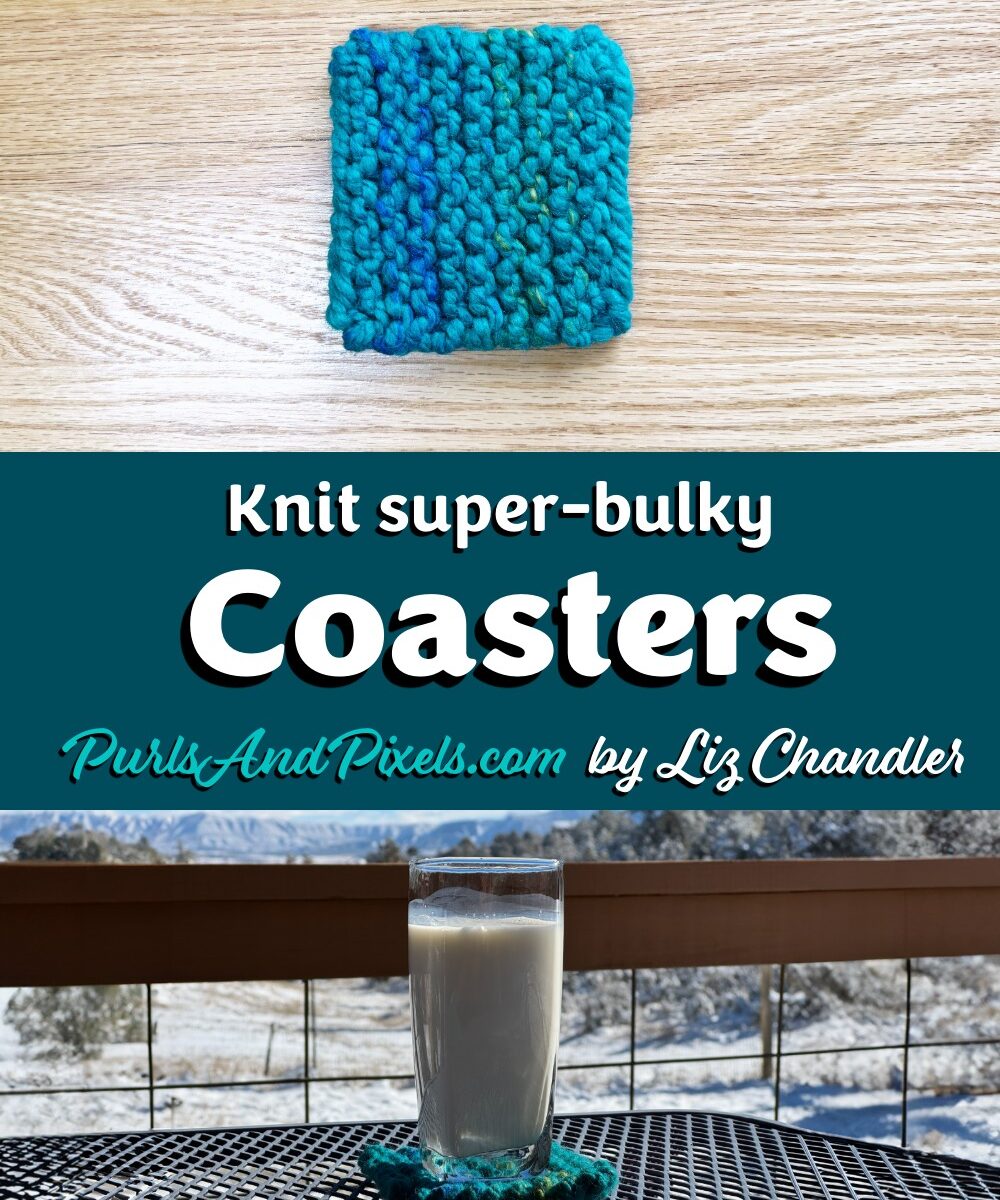
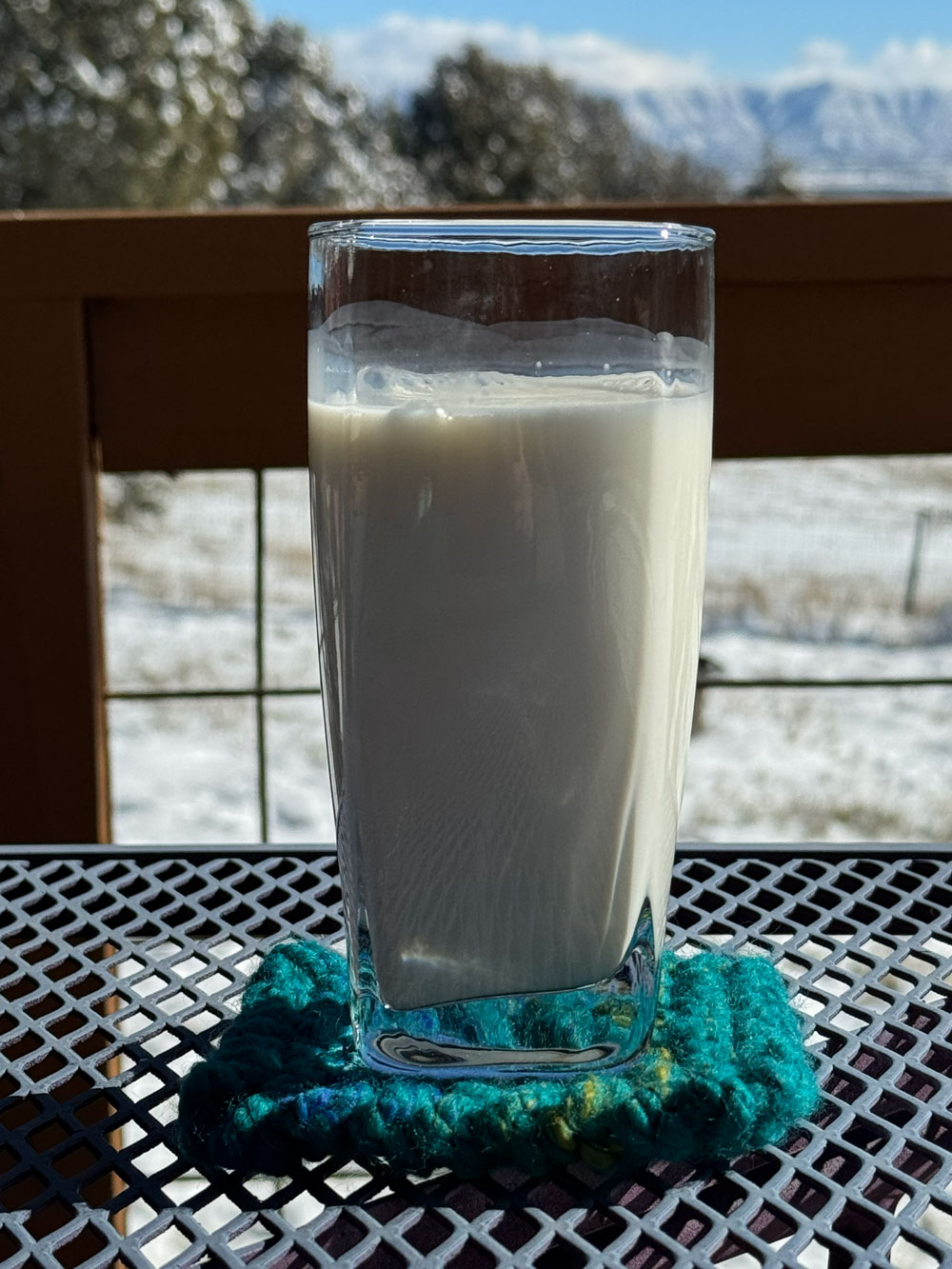
Learn to knit super-bulky coasters with this free knitting pattern. This is the first pattern in Liz Chandler's Kids' Knitting Guide. Pictured indoors on a wooden table and outdoors in a snowy landscape on a purple patio table with a glass of milk resting on top.

This super-bulky knit coaster is intentionally designed as a first knitting project and has been used successfully by kids and adult beginners learning to knit. The pattern limits techniques to one stitch (the knit stitch), uses a flat square shape, and works with thick, easy-to-see yarn so beginners can practice tension and stitch counting without getting overwhelmed. There is no shaping, no stitch pattern changes, and no decisions to make once you begin knitting.

This article explains how to knit a super-bulky coaster, with step-by-step instructions suitable for complete beginners. You will knit a small flat piece using only the knit stitch, then bind off and weave in your ends to create a finished coaster you can use every day.

A completed blue Beginner Super Bulky Knit Coaster made from the Free Knitting Pattern by Liz Chandler resting atop a purple outdoor table with a winter mountain scene and a glass of milk on the coaster.

On this page: About · Materials · Gauge · Printable PDF · Instructions · Care · Sharing

About This Beginner Super-Bulky Knit Coaster

This simple knit coaster is intentionally small, forgiving, and repetitive. As Project 1 in my Kids’ Knitting Guide, the beginner super-bulky knit coaster introduces how knitting feels in your hands and how stitches stack row by row, without asking beginners to switch stitches or manage complicated shaping.

Using super bulky yarn allows new knitters to see each stitch clearly and finish projects quickly. The goal is not perfection, but comfort and familiarity with the knitting process.

Materials

Knitting Needles

Yarn

One 106-yard (6-ounce) skein of super-bulky (No. 6) yarn* (shown in Wool-Ease Thick and Quick by Lion Brand Yarn “Bluegrass”), in your choice of color).

  • One coaster uses approximately 10.6 yards (0.6 oz.)

*Weights estimated with Wool Ease Thick & Quick by Lion Brand Yarn; other yarn weights may vary.

Notions

Gauge

10 stitches x 18 rows = 4 x 4 inches in Garter Stitch on No. 13 (9.0 mm) needles. Gauge is typically measured in stockinette stitch, but this project uses garter stitch throughout, so gauge is measured in garter stitch to reflect the finished fabric. Exact gauge is not critical for this project. And, honestly, if you’re a brand new beginner, don’t worry about it. Just start following the pattern.)

Abbreviations

k = knit

Skills Used

This super bulky knit coaster is a great first knitting project because it’s simple, fast, and easy to finish in one sitting. To make the super bulky knit coaster, you’ll only need to know how to:

This coaster is worked in garter stitch, which means every row is made using the knit stitch. Repeating the same stitch over a short project like this is a great way to practice and build confidence.

As you knit, try to keep your stitches even on the needles. They should be snug, but not tight. The stitches should slide easily so you can insert your needle into each loop without forcing it. Finding that balance takes practice, and this small project makes it easier to learn.

Want to knit along with me? I’ve made a video lesson that shows how to knit this coaster from cast on to bind off. Visit the How to Knit a Coaster lesson for step-by-step help. 🧶

A finished super-bulky knit coaster in teal tones held in a hand in front of a purple porch table and snowy mountain scene.

Prefer to knit offline?

This pattern is free to read below, but if you’d rather print it or save it for later, I’ve created a clean, ad-free PDF version for you.

  • Includes materials list and complete knitting instructions
  • Easy to print or use on your tablet
  • Supports my small business 💖
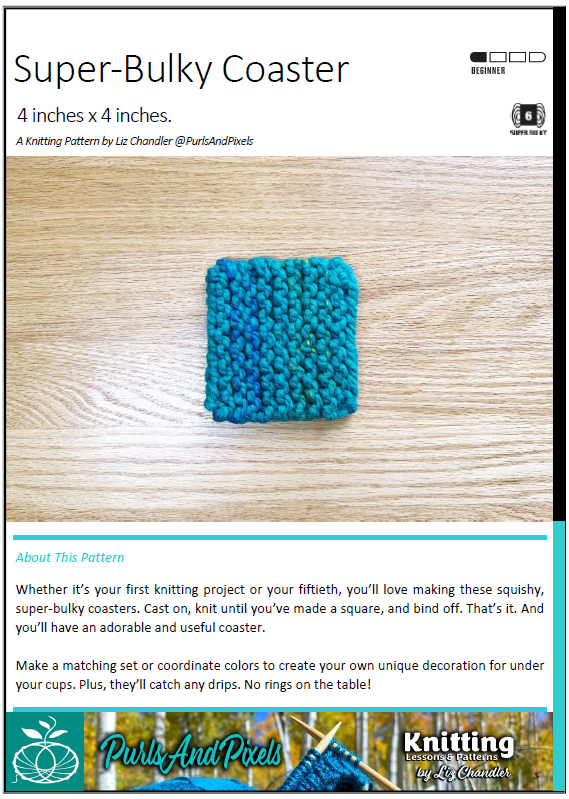
Cover of Super-Bulky Coaster knitting pattern PDF by Liz Chandler

Instructions: Beginner Super-Bulky Knit Coaster

(4 inches [10.16 cm] x 4 inches [10.16 cm])

Use the Long-Tail Cast On method. Knit flat, turning after each row.

Row 1: Cast on 10 stitches. (10 stitches) Turn.

Rows 2 – 18: k 10. (10 stitches) Turn.

Row 19: Bind off loosely.

Cut yarn, leaving an 8-inch (20.32-cm) tail, and pull through. Weave in ends. Block if desired.

Save or print this pattern

Printable version of this free knitting pattern

Get the PDF version of this Beginner Super-Bulky Coaster Knitting Pattern.

Care

If you use the materials called for in the pattern, your final product will be machine washable. To keep your coasters looking their best, hand wash or machine wash separately on delicate cycle in cold water. Lay flat to dry. 

🛁Read more Knitwear Care Tips

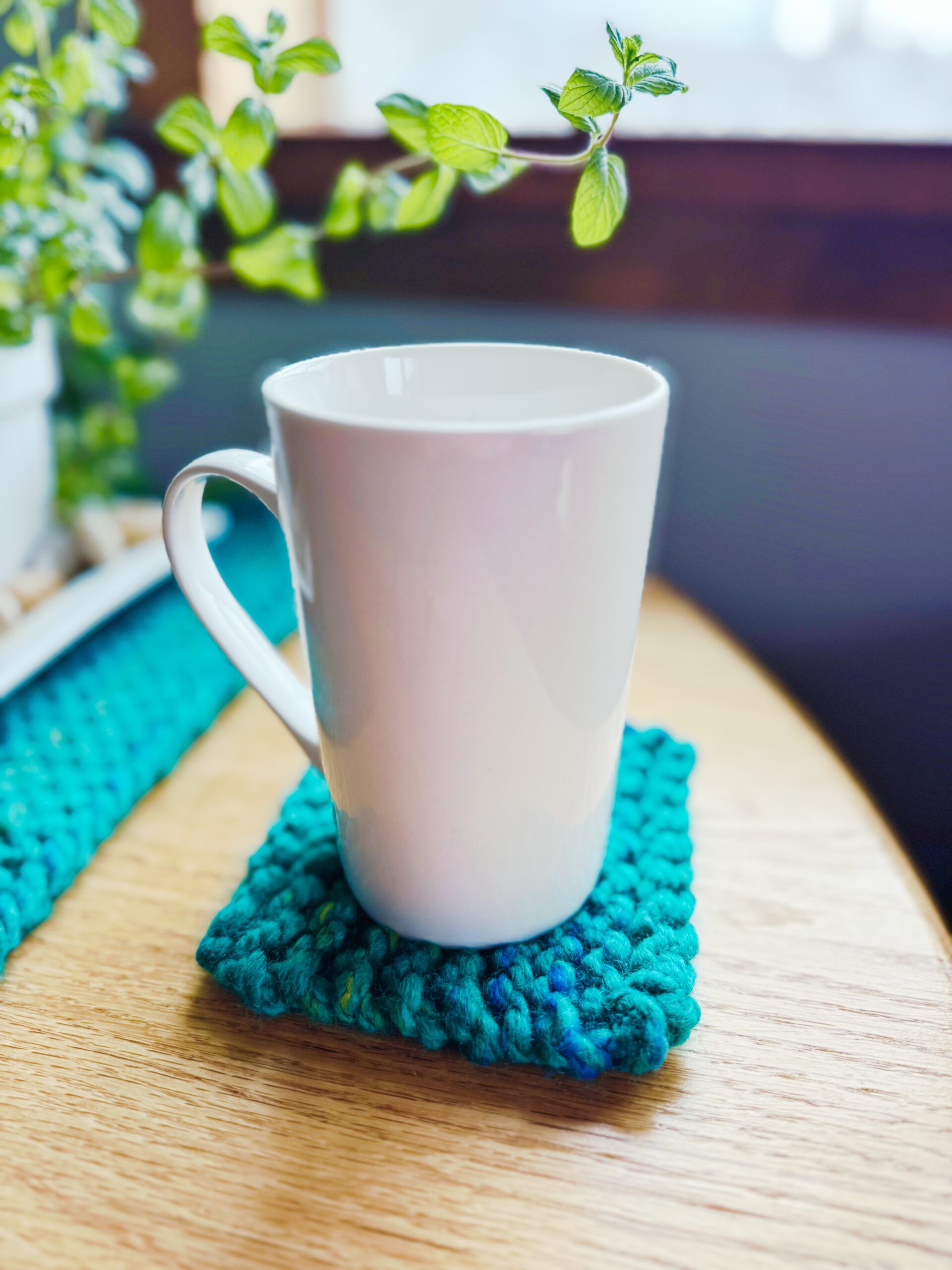
A white coffee cup sits on top of a beginner knit coaster knit with blue super-bulky yarn on a wooden table near a window and potted plant.

Copyright, Sharing, and Selling Finished Items

©2025, Liz Chandler of PurlsAndPixels.

This pattern is for personal use, gifting, and charitable donation of completed items. You may also sell handmade items created using this pattern. Do not copy this pattern and distribute it. If you’d like to share the pattern, refer your friends to my website, purlsandpixels.com so they may obtain a copy.

If you find any errors or have any questions, email purlsandpixels@gmail.com and I will do my best to help.

I’d love to see your finished work! Tag your photos with @PurlsAndPixels on Twitter or Instagram.

More Knitting Patterns You’ll Love

🧶 Next: Beginner Super-Bulky Knit Placemat- Free Knitting Pattern

🧺 All Knitting Patterns

Don’t Miss a Stitch 💌

Love cozy knitting projects? Follow along on YouTube, Pinterest, and Instagram,
or join the newsletter for more free patterns and gentle knitting tips.

What Does “BO” Mean in Knitting?

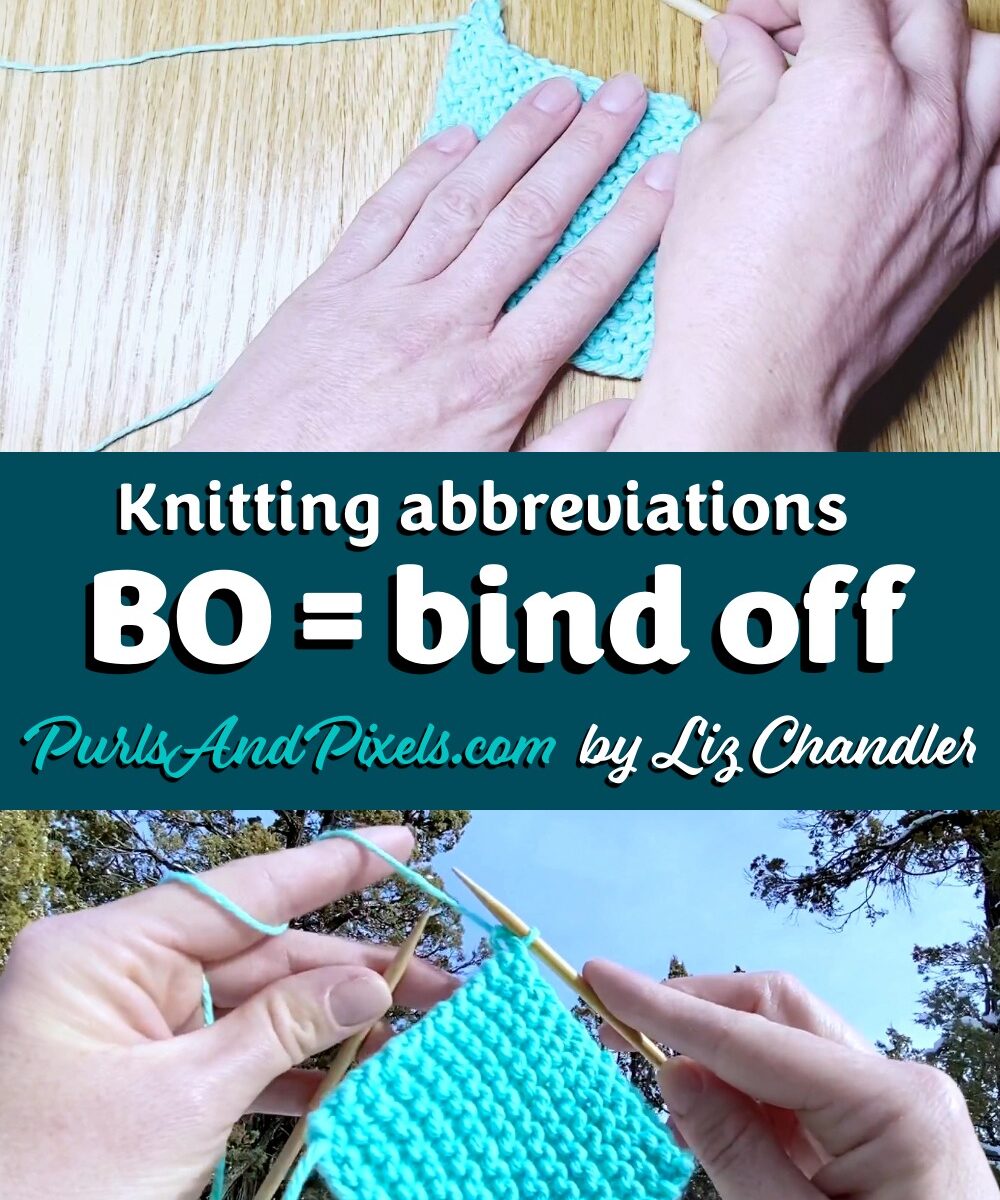
Knitting Abbreviations: BO= Bind Off. Or be over depending on your day. Find more knitting abbreviations from Liz Chandler @PurlsAndPixels.

Hint: Sometimes It Means Be Over 🧶

Every knitting project eventually needs to end, and that is where BO comes in. In a pattern, BO = bind off.

It is the instruction that tells you how to finish your stitches so they do not unravel. Think of it as plating up your dish after cooking—it seals everything together so it is ready to enjoy.

👉 Example: “BO all sts” means “bind off all stitches.”

The Real Meaning of BO in Knitting

Binding off closes the stitches on your needle. Without it, your work would quickly unravel. Just as casting on is the start, binding off is the finish line.

How to Take Knitting Stitches Off the Needles – Bind Off Knit Stitches

There are different bind off methods (standard, stretchy, sewn), but they all secure your stitches so your project is complete.

👉 Want to learn step by step? Learn the standard bind off in my free lesson.

The Twist: BO = Be Over

Sometimes the best part of a project is finishing it. When you bind off that last stitch, it means the counting, the tangles, and the endless rows can finally be over. 🥳

So remember: BO = Be Over. The project is done, ready to show off or wrap up as a gift.

Knitting Abbreviations: BO= Bind Off. Or be over depending on your day. Find more knitting abbreviations from Liz Chandler @PurlsAndPixels.

Why BO Matters for Beginners

Binding off is what makes a project usable. Without it, you just have loose loops. With it, you have something finished, secure, and ready to wear or gift.

✨ Want to practice? Try these beginner-friendly projects:

🛁 Your First Washcloth

🧣Easy Garter Stitch Scarf

🧶 Beginner Classics Pattern Bundle

📚 Knitting Pattern Library: Explore more patterns

These easy patterns are a great place to start, knit, and bind off. They’re so simple, they’ll be over before you know it!

Find More Abbreviations

Visit the Knitting Abbreviations Main Page to see the whole series.

What’s Next?

Now that you know BO = bind off (and sometimes be over), you are ready to keep exploring the knitting shorthand. Next up: **= repeat the pattern between the asterisks.

👉 Don’t miss the rest of the series. Sign up for my email updates below and I will send the next lesson straight to your inbox!